|
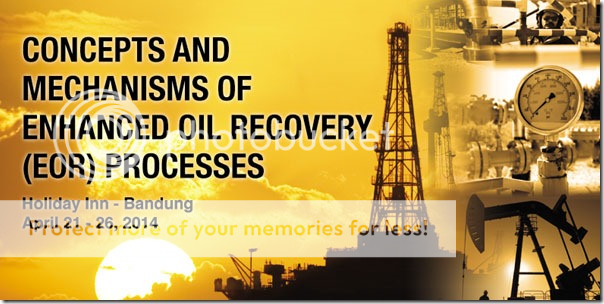
Most oil companies and governments are evaluating possible enhanced oil recovery (EOR) applications especially in mature fields with limited remaining potential under primary and/or secondary recovery phases. Implementation of any EOR process requires very long time for selection, laboratory and field tests, reservoir studies, design and procurement. Accordingly, early start of EOR evaluations is vital to assure its implementation in reasonable time frame while field production is still economical and prices of EOR materials are affordable.
Unlike primary and secondary recovery operations, all EOR processes are complex, costly and require careful design and optimization as well as competent technical staff. These processes include miscible solvent, alkaline, polymer, surfactant, steam and in-situ combustion; and it is essential to select the appropriate process for the given reservoir. After a suitable process is selected, some analyses and studies are conducted to assure the applicability of the main mechanisms and to provide design parameters such as material type, concentration, volume, operating conditions, flood pattern and well design.
It should be noted that in spite its difficulties, expense and long implementation time; EOR is still considered attractive and promising for increasing oil reserves from existing fields. Successful EOR applications throughout the world indicate increased ultimate oil recovery factors up to 75% of the original oil in place.
|
 |
Dr. Ezzat Goma
Dr. Gomaa was born in Egypt and is now a citizen of USA. Dr. Gomaa graduated B.Sc. in petroleum/geological engineering, Cairo University, Egypt, 1966 and finished his M.Sc. in mechanical/petroleum engineering, University of California, Berkeley, 1971 (Thesis: Factors Affecting Compressibility of Reservoir Rocks) and continuing PhD in mechanical/petroleum engineering, University of California, Berkeley, 1973 (Thesis: Thermal Behavior of Partially Liquid-Saturated Porous Media).
In industry Dr. Gomaa started his career with several staff and supervisory assignments in reservoir engineering, reserves estimation, reservoir simulation, enhanced oil recovery and geothermal evaluation with Chevron Corporation, USA (1973 – 1983), Caltex Corporation, Indonesia (1983 – 1986), and Amoseas, Indonesia 1986 – 1989. From 2002 – present as consultations services in reservoir engineering, simulation studies and enhanced oil recovery applications for Medco E&P Indonesia, Kondur Petroleum, Pertamina and Medco LLC, Oman.
In academic Dr. Gomaa actively teaches in petroleum engineering at Cairo University, Egypt (1966 – 1969), University of California, Berkeley, USA (1975 – 1976), Institute of Technology, Bandung, Indonesia (1985 – 1988), and Trisakti University, Jakarta, Indonesia (1986 – 1987).
In professional oil & gas industry, Dr. Gomaa provides In-house and professional training courses in USA (1973 – 1983), Saudi Arabia (1982), Indonesia (1997 – present) and Oman (2006 – present) on basic & applied reservoir engineering, reliability of PVT & core analyses, practical aspects of reservoir simulation, use of geostatistcs in reservoir modeling, enhanced oil recovery, steamflood operations, and methods of improving well productivity.
Dr. Gomaa has published several litterateurs in professional oil & gas and technical papers, some of them are for the Society of Petroleum Engineers related to enhanced oil recovery and geothermal reservoir engineering and several course notebooks for in-house and professional training courses. Dr. Gomaa also registered US patent on use of optimum steam quality in steamflood oil recovery.
|
|
Day One: Monday, April 21, 2014
- Oil recovery phases
- Definition of oil recovery factors
- Need for EOR
- Overview of EOR processes
- Key rock and fluid properties
- Class problems and examples
Day Two, Tuesday, April 22, 2014
- Key EOR mechanisms
- Displacement efficiency in immiscible floods
- Displacement efficiency in miscible floods
- Volumetric sweep efficiency
- Fluid trapping in reservoir rocks
- EOR screening and evaluation guidelines
- Class problems and examples
Day Three, Wednesday, April 23, 2014
- Phase behavior diagrams for hydrocarbons
- Types of miscibility
- Comparison of solvents for miscible flood
- Designing a miscible flood
- Miscible slug processes
- Water-alternating gas (WAG) processes
- Estimating oil recovery factors
- Miscible flood field case
- Class problems and examples
Day Four, Thursday, April 24, 2014
- Polymer characteristics
- Comparison of polymers
- Viscosity of polymer solutions
- Inaccessible pore volume
- Permeability reduction and viscoelastic effects
- Polymer degradation and retention in reservoir rocks
- Type and required amount of polymer
- Surfactant characteristics and phase behavior of surfactant-oil-water systems
- Optimal salinity and capillary de-saturation curves
- Surfactant retention in reservoir rocks
- Thin film spreading agents
- Class problems and examples
Day Five, Friday, April 25, 2014
- Type and required amount of surfactant
- Alkaline characteristics
- Effect of chemicals on fractional flow
- Estimating oil recovery factor for chemical floods
- Chemical flood field cases
- Thermodynamic properties of steam
- Heat losses in steam injection processes
- Steam generation and co-generation of steam and electricity
- Class problems and examples
Day Six, Saturday, April 26, 2014
- Mechanisms of cyclic steam stimulation
- Steamflood mechanisms
- Phase splitting in steam distribution system
- Steam quality measurements
- Casing vapor collection system
- Injection profiles and steamflood optimization
- Optimum flood patterns and vertical stages
- Conversion from stem to water injection
- Prediction of steamflood performance
- Cyclic steam stimulation field case
- Steamflood field case
- Class problems and examples
|
EARLY BIRD,
gets 5% discount |
REGULAR FEE |
Rp. 38.000.000,- /pax *) VAT not yet included
Total with VAT 10% is Rp. 41.800.000,-/pax
for payment before March 28th 2014 |
Rp. 40.000.000,- /pax *) VAT not yet included
Total with VAT 10% is Rp. 44.000.000,-/pax
Valid from March 29th, 2014 onwards |
GROUP OF 3 PARTICIPANTS,
gets 7.5% discount |
GROUP OF 5 PARTICIPANTS,
gets 10% discount |
Rp. 37.000.000,-/pax *) VAT not yet included
Total with VAT 10% is Rp. 40.700.000,-/pax
for payment before April 4th 2014 |
Rp. 36.000.000,-/pax *) VAT not yet included
Total with VAT 10% is Rp. 39.600.000/pax
for payment before April 4th 2014 |
All package includes:
- 6 (Six) DAYS COURSE
- Accommodation at HOLIDAY INN Bandung during workshop
- Certificate of Completion of EOR Workshop
- Training Kits
- Refreshments
- Networking Dinner & Entertainment
- Merchandise
Payment & Registration
PT. INOVASI SAMUDERA BIRU
Bank: BCA Rawamangun
Acc No. : 0947147009 (IDR)
SWIFT Code:CENAIDJA |
Terms & Conditions:
Cancellation Fee:
- On/after April 7th, 2014: Charge 50%
- On/after April 14th, 2014: Charge 100%
Payments: Payment must be made prior
to the event running
|

| “Bring your laptop & let’s solve your study case here!” |
|