

Asiamet extends high grade copper mineralization beneath BKZ deposit
Tuesday, November 14 2017 - 01:20 AM WIB
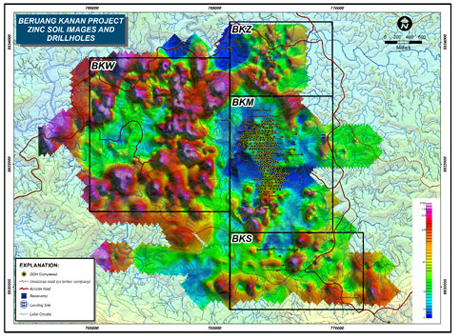

TSX-listed Asiamet Resources Limited (ARS) reported on Monday that ongoing exploration drilling at the BKZ Polymetallic (BKZ) prospect located on its Kalimantan Surya Kencana (KSK) 6th Generation Contract of Work (CoW), in Indonesia?s Central Kalimantan Province continues to intersect, near surface high grade base and precious metal rich mineralization.
Highlights to date include:
BKZ contains massive sulphide or vein style mineralization that is confirmed over a strike length of 225 meters, is up to 110m in east-west dimension and has a variable interpreted true thickness of 8m to 39m.
Three holes have intersected high grade copper mineralization immediately beneath the high grade polymetallic Zn-Pb-Cu-Ag-Au mineralization, confirming a strike length of at least 110m and a true thickness of up to 50m. Copper mineralization remains open to the south, east, west and down-dip.
High grade copper-silver mineralization is interpreted to occur within a primary feeder structure to the BKZ polymetallic mineralization, with up to 11.8 percent copper and 415g/t silver reported over 1-metre sample intervals.
The copper mineralization at BKZ is potentially controlled by the same major structure that controls the location of mineralization at the BKM Copper Project to the south, and as such indicates potential for continuity of structurally controlled copper mineralization over 800 metres of strike between BKZ and BKM.
The BKZ scout drilling program comprises a total of 14 holes for 1,354 meters of diamond core drilling. The scout drill rig is currently at Beruang Kanan West (BKW) prospect, testing several coincident copper in soil, rock and chargeability anomalies.
Drilling summary is a follows.
The first hole on section line BKZ33600 was drilled west at -55 degree dip to confirm continuity of mineralization between section lines BKM33650. BKZ33600-01 (82.4m End of Hole ?EOH?) intersected a 4m wide zone of high grade polymetallic mineralization from 34.0m depth hosted in quartz-sulphide veins to massive sphalerite (zinc), galena (lead), chalcopyrite (copper) and pyrite.
The second hole on section line BKZ33600 was collared on the same drill pad, drilling east at -70 degree dip. BKZ33600-02 (89.6m EOH) intersected an upper zone of polymetallic mineralization from 31.0m depth hosted in quartz-sulphide veins to massive sphalerite (zinc), galena (lead), chalcopyrite (copper) and pyrite. The hole also drilled through a lower feeder zone of high grade copper-silver mineralization from 59m depth. The high grade copper mineralization is contained within a dense stockwork of quartz-sulphide and sulphide veins containing bornite, chalcopyrite and pyrite. Individual 1-metre intervals assayed up to 5.16% copper and 46g/t silver. The hole was terminated due to technical issues, and ended in mineralisation.
The third hole on section line BKZ33600 was collared on the same drill pad, drilling southeast at -55 degree dip. BKZ33600-03 (125.0m EOH) also intersected an upper zone of polymetallic mineralization from 39.0m depth hosted in quartz-sulphide veins with sphalerite (zinc), galena (lead), chalcopyrite (copper) and pyrite. The hole also drilled through a broad zone of high grade copper-silver mineralization starting at 72m depth and a second zone at 88m depth. The high grade copper mineralization is contained within a high stockwork vein density of quartz-sulphide and sulphide veins containing bornite, chalcopyrite and pyrite. Individual 1-metre intervals assayed up to 11.8 percent copper and 19.5g/t silver. The hole was terminated due rig capacity, and ended in mineralization.
Asiamet said multiple intersections of high grade copper-silver mineralization within a feeder structure at BKZ is very significant. This high grade copper-silver mineralization remains open along strike to the south, east, west and at depth, and further drilling is required to determine its dimensions and continuity.
Additional drill pads are being prepared south of the BKM33600 drill fan and the company rig located at BKW will complete the current hole and then move back to BKZ. Exploratory drilling will continue to test the strike, width and downdip continuity of the interpreted feeder structure in the southern part of BKZ.
Peter Bird, Asiamet?s Chief Executive Officer commented: Asiamet is pleased to report that ongoing exploration in the BK district continues to make very significant progress. We have been very successful in both discovering new mineralization and also advancing our understanding and drill targeting. Since recommencing exploration two months ago our strike rate has been exceptional. A major north-south basement structure has been identified which controls a district scale polymetallic mineral system and within which we have already defined a very significant copper deposit at BKM. Our scout drilling program has confirmed a suite of other prospects and mineral occurrences within the immediate infrastructure footprint of the proposed BKM copper development which need to be systematically evaluated. The BKZ mineralization is one such area and as we have previously indicated, represents a potential stand-alone polymetallic project. The discovery of a copper feeder zone at BKZ with potential for considerable strike and depth extent has some exciting implications for the wider project and we are looking forward to reporting further exploration results over the coming weeks and months while the BKM feasibility study is being completed.?
Editing by Reiner Simanjuntak