

Draft gives government export carte blanche for minerals
Saturday, January 7 2017 - 05:29 AM WIB
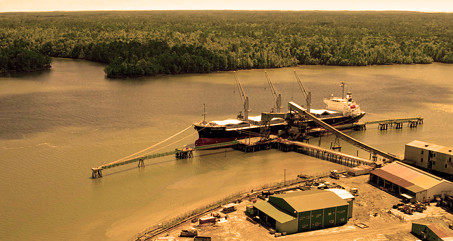

Courtesy of Freeport
As the deadline nears for a total ban on the export of raw and partly processed mineral products after January 11, a recent government regulation draft aims to extend the current easing of export restrictions, The Jakarta Post reported on Saturday.
Under the draft, dated January 4, a copy of which was obtained by The Post late on Thursday, mining companies can still export partly processed minerals, and that a decree from the Energy and Mineral Resources Ministry will determine the commodities eligibility for export.
The draft is the fourth revision to Government Regulation No. 23/2010 on the management of mineral and coal businesses, and is basically similar to the existing policy in which the government has allowed only the export of copper concentrates despite Law No. 4/2009 on mining, prohibiting such exports.
However, the recent draft is deemed too vague, and therefore subject to abuse because of the huge authority the Energy and Mineral Resources Ministry has in determining the commodities eligibility for export.
?It?s like giving the ministry carte blanche in determining which commodities can and cannot be exported,? an official involved in discussing the draft told the Post on Friday.
Energy and Mineral Resources Minister Ignasius Jonan remained tight-lipped on the issue, saying only that he had sent the draft to Coordinating Economic Minister Darmin Nasution. ?We have already sent the draft, it is all up to him [Darmin],? he said on Thursday.
The latest draft was put together by the Office of the Coordinating Economic Minister based on meetings with echelon I officials from various ministries. The draft was submitted on Wednesday to the Law and Human Rights Ministry for examination before being submitted to President Joko ?Jokowi? Widodo for approval.
An article prohibiting the exports of nickel and bauxite had been deleted from the previous draft submitted by the Energy and Mineral Resources Ministry to the Office of the Coordinating Economic Minister on Dec. 28.
?With the prohibition lifted for nickel and bauxite from the previous draft, it is very possible the commodities can be exported because it will only need ministerial approval,? said the official.
Easing the policy will only harm companies that have poured billions of US dollars into the construction of smelting plants to process the raw products for export.
Secretary to the Office of the Coordinating Economic Minister Lukita Dinarsyah Tuwo, who signed the cover letter in the latest draft, could not be reached for comment.
The deputy chairman for the House of Representatives? Commission VII overseeing energy and mining, Satya Yudha, warned the government not to move forward with the plan as it would violate the 2009 Mining Law.
?We warn the government not to approve the draft regulation to avoid igniting [political] trouble in the future,? said Satya of the Golkar Party.
The government is rushing to decide whether to relax or to fully enforce the ban, as mandated by the law before the Jan. 11 deadline.
The law stipulates that mineral ore miners must complete their smelters by 2014, when the export ban should have been fully put in place. The smelters are expected to bring in added value to the end products.
However, because none of the proposed smelters had been completed, the deadline was extended to 2017 by then president Susilo Bambang Yudhoyono when he issued Government Regulation No. 1/2014 as an amendment to the 2010 government regulation.
Maintaining the current policy will only benefit gold and copper miner PT Freeport Indonesia, a subsidiary of United States giant Freeport McMoRan, and copper producer PT Newmont Nusa Tenggara, which was recently taken over by local energy firm PT Medco Energi Internasional from US-based Newmont Mining Corp.
Despite the ban, the companies have been allowed to export copper concentrates as they have pledged to construct smelting plants and have agreed to pay export taxes at rates in accordance with the progress of construction, which has been stalled.
However, under the new draft, they are required to convert their contracts of work ? signed prior to the 2009 Mining Law ? into special mining licenses (IUPK) before they can receive similar facilities. (*)