

Geomarin III vessel unveils biogenic gas exploration results
Monday, May 22 2017 - 03:18 AM WIB
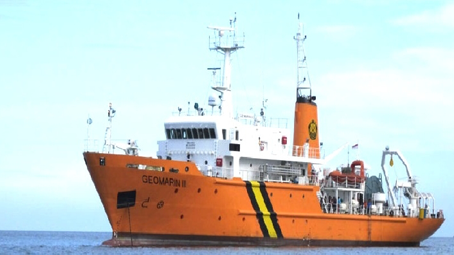

The Marine Geology Development and Research Center (or P3GL) of the Ministry of Energy and Mineral Resources held on Saturday an ?open ship? event at the Benoa Port in Bali to unveil the results of recent biogenic gas exploration conducted by the Geomarin III research vessel in the North Bali Basin.
The ministry?s Directorate General of Oil and Gas said in a statement that the vessel conducted exploration activity from April 26-May 18, 2017.
The statement said that aside from North Bali, there are 10 other basins recommended to be studied by P3GL including basins in Sibolga, Central Sumatra, South Sumatra, northern part of West Java, northern part of East Java, Barito, Kutai, Tarakan, Sengkang, and Waipoga. Seven basins have been proved to contain biogenic gas and three basins considered as frontier basins, it said.
The statement said that biogenic gas is not the main target of oil and gas exploration activities. Much of biogenic gas are found accidentally, while searching for conventional oil and gas, at a depth of 500-1,000 meters thus making the cost of exploration, drilling and production relatively cheaper.
About 20-30 percent of the world?s gas reserves are classified as biogenic gas of around 4 trillion cubic feet (tcf), of which some are produced in Indonesia. Only about 3.8 percent of Indonesia?s 104 tcf gas reserves are in the form of biogenic gas.
An example of the use of biogenic gas in Indonesia is at the Kepodang gas field in Muriah block, with production rate of 354 mmscfd of gas, supplied via a 207-km pipeline to the Tambak Lorok combined cycle power plant (PLTGU) in Semarang, Central Java. The Kepodang gas field accounts for 600 MW of the power plant?s total capacity of 1,000 MW.
The statement said that at the ?open ship? event, it was also announced plan for the Geomarin III vessel to start (scheduled on Sunday) ocean thermal energy survey in the North Bali waters. Ocean thermal energy is considered as part of renewable energy sources.
The statement said that Indonesia holds the world?s largest ocean thermal energy potential scattered in the western coast of Sumatra, southern Java, Sulawesi, North Maluku and Bali. P3GL has studied the potential in 17 locations totaling 41 GW.
Editing by Reiner Simanjuntak