
Government reinforces raw mineral export ban to drive downstream industry
Thursday, October 16 2025 - 08:00 AM WIB
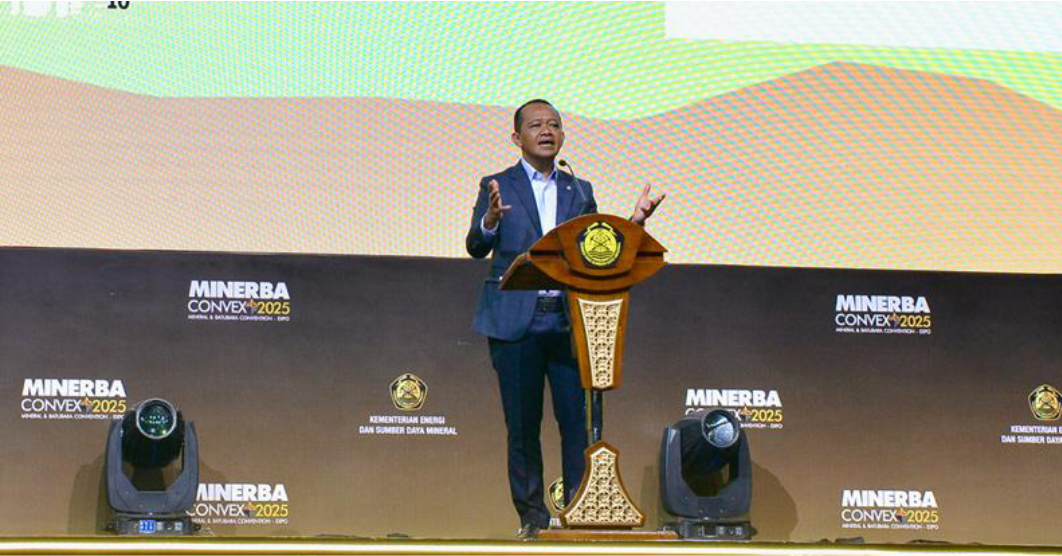
Indonesian Minister of Energy and Mineral Resources (ESDM) Bahlil Lahadalia reaffirmed that the government will no longer allow the export of raw minerals, underscoring Indonesia’s continued commitment to downstream processing and the industrialization of the mineral and coal mining sectors.
Speaking at the opening of the 2025 Mineral and Coal Convention and Exhibition (Minerba Convex) at the Jakarta International Convention Center on Wednesday (Oct. 15), Bahlil said that downstreaming and industrialization are key to building a more advanced and self-reliant Indonesia, despite facing challenges both domestically and internationally.
“Many have come to lobby me to lift the export ban for raw materials. I told them — if we keep doing this, what’s the difference from the VOC era? We can’t keep using outdated methods. I said, stop. We are turning a new page for our nation,” Bahlil said, drawing applause from the audience.
He noted that Indonesia’s ban on raw mineral exports has faced resistance from other countries, citing the European Union’s complaint at the World Trade Organization (WTO) over Indonesia’s nickel ore export ban. “When Indonesia starts moving in the right direction, there will always be those who feel uncomfortable — from outside or even inside the country. But to carry out the President’s directives, I won’t back down even an inch. This is about our national sovereignty,” he stressed.
Bahlil emphasized that downstreaming has revealed the hidden value in minerals previously exported as raw materials. For instance, copper concentrate — though not categorized as a raw mineral — still contains significant amounts of gold. PT Freeport Indonesia produces around 3 million tons of copper concentrate annually, yielding about 60 tons of gold, while PT Amman Mineral Nusa Tenggara’s 900,000 tons of concentrate produce around 20 tons of gold each year.
“I want to reiterate what the President always reminds us — that our natural resources and mining assets should not be exploited all at once. We must remember the generations that come after us. We must manage them responsibly, in an environmentally sustainable way, and in accordance with the law,” Bahlil said.
Read also: Indonesia enforces copper concentrate export ban starting January 2025
Following the President’s directive, the government has temporarily suspended the operations of 190 mining permit (IUP) holders for failing to deposit mandatory reclamation and post-mining guarantee funds. This financial requirement ensures that reclamation can still be carried out even if a company fails to do so, with the government using the available guarantee funds to restore the land.
“That’s one of the requirements for submitting a RKAB (Work Plan and Budget). You must provide a reclamation guarantee fund. The fact is, some companies finish mining and leave without doing reclamation. So who will take responsibility?” he asked.
Meanwhile, the Director General of Minerals and Coal at the Ministry of ESDM, Tri Winarno, said that one of the main focuses of Minerba Convex 2025 is sustainable mining management — emphasizing not only economic growth but also social responsibility and environmental protection.
“Minerba Convex 2025 includes special sessions such as coaching clinics for mining companies to help them understand the importance of environmentally responsible practices, including the obligation to provide reclamation guarantee funds. This is part of our shared commitment to balance productivity with sustainability,” Tri said.
He added that discussions on advanced materials — vital for the development of high-tech industries — are also among the key themes of this year’s event.
“These advanced materials are used in cutting-edge industries, which is why they are classified as strategic and critical minerals. In Indonesia, exploration of such minerals — including rare earth elements — has already begun. This effort continues because data is still limited and incomplete compared to other metallic minerals. Geological mapping and exploration are currently being carried out by the Geological Agency,” Tri explained.
Editing by Reiner Simanjuntak