

Inalum amends MoU on aluminum cluster project in N. Kalimantan
Monday, November 27 2017 - 01:16 AM WIB
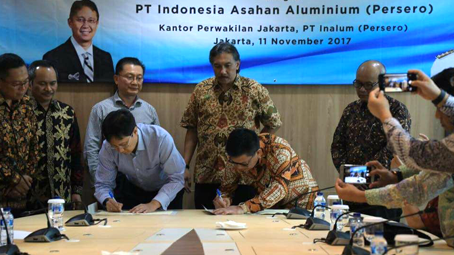

State-owned aluminum producer PT Indonesia Asahan Aluminium (Inalum) has recently signed amendment to a June 6 MoU with the North Kalimantan provincial administration in relation to the company?s plan to develop an aluminum cluster at the KIPI industrial estate in the province.
Inalum said in a statement obtained Monday that the new MoU was signed by company President Director Budi Gunadi Sadikin and North Kalimantan Governor Irianto Lambrie, which was witnessed among others by CEO of PT Kayan Hydro Energy, Chandra Lee. The latter company plans to develop a hydro power plant in the province with total capacity of 9,000 MW to supply power for various tenants at the industrial estate in Tanah Kuning including for Inalum?s aluminum project.
Budi said in the statement that his company expects the support of the North Kalimantan administration in realizing the aluminum project including in terms of acceleration of the provision of land for the project, and the proposed power plant project by Kayan Hydro. He said that the project will require around 800 ha of land.
He said that the aluminum project forms part of the company?s expansion strategy. He said that by 2025, Indonesia?s aluminum demand is projected to jump to 2 million tons per annum, compared to Inalum?s current production capacity of only 250,000 tons per year in North Sumatra. Indonesia currently relies on import to help meet demand due to the limited capacity of Inalum, the only producer of aluminum in the country, which is among the world?s top five producer of bauxite ores, the raw material for aluminum production.
This portal previously reported that the Inalum aluminum cluster project in North Kalimantan will comprise of aluminum ingot production facility with installed capacity of 500,000 -1 million tons per year, and downstream industries to produce wire rod with production capacity of 100,000 tons per year, and aluminum alloy with production capacity of 300,000 tons per year. In the first phase, the company will require electricity supply of 800 MW.
Editing by Reiner Simanjuntak