

Indonesia cuts 2026 coal output to about 600 Mt, adjust nickel quotas to industrial demand
Thursday, January 8 2026 - 03:00 PM WIB
By Cepi Setiadi
The Indonesian government is planning to reduce the country’s coal production target in 2026 to around 600 million tonnes, down from an estimated 790 million tonnes in 2025, as part of efforts to rebalance global supply and demand and support coal prices.
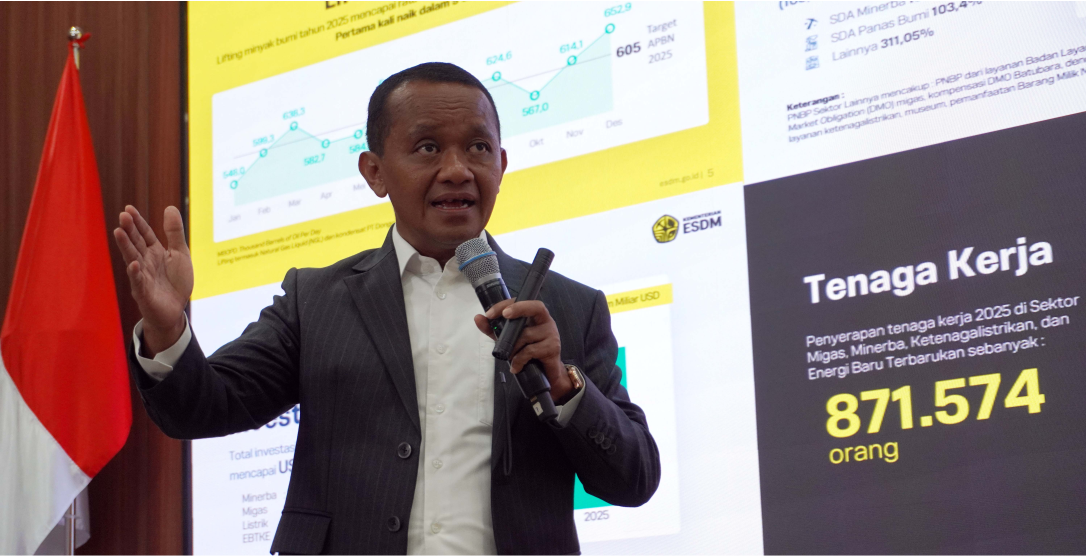
Minister of Energy and Mineral Resources (ESDM) Bahlil Lahadalia said Indonesia’s dominant position in the global coal market has contributed to oversupply and downward pressure on prices. Of the roughly 1.3 billion tonnes of coal traded globally, Indonesia supplies about 514 million tonnes, or around 43%.
“Coal production in 2025 is around 790 million tonnes, with 65.1% exported and about 32% allocated for domestic use under the DMO. All targets were achieved. But because Indonesia supplies such a large share of global trade, we need to rebalance production,” Bahlil said at the ESDM Ministry on Thursday (Jan 8).
He said the ministry is reviewing and revising coal Work Plan and Budget (RKAB) quotas for 2026, with production likely to be set at around 600 million tonnes, although the final figure could be slightly higher or lower. The government does not plan to impose a rigid production cap.
Domestic demand will remain the top priority. Bahlil said the Domestic Market Obligation (DMO) allocation will be adjusted as needed to ensure local demand is fully met before coal is allowed to be exported.
“If the RKAB is set at 600 million tonnes and a 20% DMO is not sufficient, then we will increase the DMO. Domestic demand must be fulfilled first, then exports,” he said.
Read also: Nickel prices rise on Indonesia quota uncertainty
The government is also studying a potential coal export levy, with tariff levels to be linked to coal price ranges and coordinated with the Ministry of Finance. Bahlil said the policy would seek a balance between state revenue and the financial health of mining companies.
“If companies are making profits, they should pay taxes. But if they are not profitable, it would not be fair to impose heavy taxes,” he said.
Beyond coal, the government plans to adjust nickel production by aligning nickel ore RKAB quotas with the actual capacity and demand of domestic processing and refining industries, to avoid oversupply and price declines.
“For nickel, supply must match industrial demand. If industrial capacity is 200 million tonnes, then nickel RKAB should be around that level. If we overshoot, prices will fall,” Bahlil said.
He also called for a more balanced nickel supply chain, urging large downstream players to source ore from local mining permit (IUP) holders to prevent monopolistic practices and ensure fair participation in Indonesia’s downstreaming drive.
Bahlil noted that policy signals on RKAB evaluations have already influenced market sentiment, with nickel prices rebounding after the government announced plans to review and restructure quota approvals.
“The objective is clear: businesses must be profitable, the state must benefit, and the people must also gain,” he said.
Editing by Alexander Ginting