

Interview: Kapuas Prima continues to deliver solid performance
Thursday, May 2 2019 - 01:36 AM WIB
By Thomas Sembiring
PT Kapuas Prima Coal, which produces lead and zinc concentrates and silver in Central Kalimantan Province, delivered strong financial performance last year. The company continued to post solid results in the first quarter of this year, providing early optimism to realize its higher full-year targets.
Revenue last year increased by 74.5 percent to Rp 759 billion from Rp 435 billion in the previous year, while net profit jumped by 145 percent to Rp 109.3 billion from Rp 44.6 billion.
In the first quarter of this year, revenue increased by 8.6 percent to Rp 201 billion, year-on-year. Net profit increased by 48 percent to Rp 60.4 billion compared to Rp 40.7 billion in the corresponding period of last year.
Set up in 2005, Kapuas Prima initially produced iron ores at its 5,569-ha concession in Central Kalimantan’s Lamandau Regency. But since 2014, the company has shifted into production of galena, which is processed into lead and zinc concentrates and silver.
The company, which went public in 2017 and listed its shares on the Indonesia Stock Exchange, has recently completed construction of a lead smelter, which is expected to start operation soon. It is also in the process of developing a zinc smelter, targeted for operation in 2021. The smelter facilities will allow Kapuas Prima to produce higher value ingots. Developing domestic smelter also forms part of conditions required by the government early in 2017 to allow mineral mining firms to continue export of mineral concentrates over a five-year period.
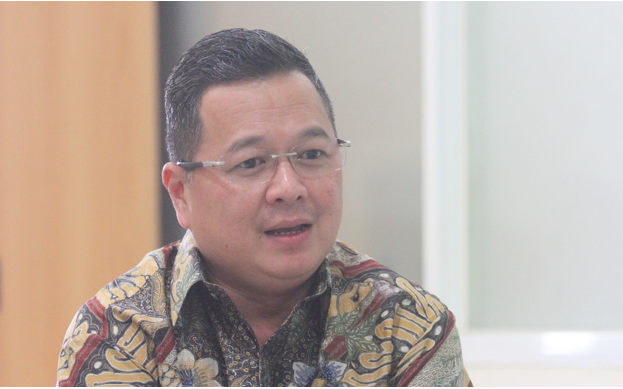
Petromindo.com/CoalAsia’s Reporter Thomas Sembiring and Photographer Mudasir recently interviewed Kapuas Prima President Director Harjanto Widjaja, discussing the company’s positive achievements and expansion plans. Following are excerpts of the interview.
Question: What was your strategy that has allowed Kapuas Prima to register strong financial results last year?
Answer: We we’re indeed surprised with the 2018 results. The first factor was higher (annual) production capacity, from only around 200,000 tons to around 300,000 tons of ores.
Another factor is that we’re blessed with ores with good purity, almost two-third of the original purity. The purity of new finds continued to improve during the first quarter (of this year), and hopefully it will sustain.
In addition, we had also taken efficiency measures. One example, we held talks with our vendors, demanding price adjustment so that we can be more (cost) efficient. For vendors which declined to (enter) negotiation, we looked for alternative products from different vendors. We’re quite serious in maintaining efficiency of our operations and production. According to our calculation, there was (improvement in) cost efficiency by around 10-15 percent last year compared to the previous year.
How is the market of your products?
We have been exporting 100 percent of our concentrates to China. There are a number of buyers including manufacturing plants, traders, and smelters.
The domestic market (for lead and zinc) is usually in the form of ingots (not concentrates), such as for battery makers, the automotive industry.
We’d been developing smelters (to produce ingots). Our lead smelter is expected to start operation at the end of this semester, while the zinc smelter (to start operation) in the next two years.
What is your production and sales targets for this year?
This year, we’ll continue to increase (production) capacity to around 450,000 tons of ores, which is quite significant especially if it’s supported with good purity.
We’ll also maintain efficiency particularly in terms of heavy equipment utilization. For example, in the area of fuel consumption. We have just revised the company operational system, and will continue to update it to ensure operational efficiency.
Sales (revenue) will certainly increase. We have set a target of around Rp 1.3 trillion (sales revenue this year), nearly doubling last year’s more than Rp 700 billion.
Assuming current rupiah exchange rate of Rp 14,200-Rp 14,500 per US dollar to remain stable, and stable prices of lead at around $2,000 per ton, zinc at $2,900-$3,200 per ton, and silver at $14-$15 per troy oz (LME data), hopefully, our (sales revenue) target can be realized.
What about the company’s business strategy for this year?
The only difference to last year’s strategy lies only in one area. The others are the same. This year, we want to focus in motivating our workers to increase their sense of ownership of the company. With such sense of ownership, certainly their efforts and loyalty will be stronger.
Of course, it is expected that this will also lead them to have an attitude of prioritizing efficiency and an attitude to protect assets. That’s why we have been conducting training programs and designed better (employee) promotion scheme.
So my intention to increase the welfare of the workers will also provide positive impact to the company’s (performance). We currently have around 120 employees, with the remainders hired by vendors.
What is your capital expenditure (capex) plan for this year?
We’ll have a quite huge capex (this year), especially as last year we made profit. As we plan to increase (production) capacity, we also need to acquire new heavy equipment to support the production plan. Capex this year is planned at around US$60 million-$75 million.
Do you also allocate funds for exploration?
Exploration is routine. We conduct exploration every month around 2,500-3,000 meters. We’ll increase this to around 5,000 meters per month, covering several exploration points. For every meter, more or less it (the cost) is estimated at Rp 1.5 million, so it would reach around Rp 3 billion per month (of exploration spending).
What will be the outlook of your operating and financial performances once the smelter starts operation?
Frankly speaking, we have IUP (mining business license) for around 5,500 hectares. We have exploited only around 390 hectares, and we have quite huge funds. If we could find new potential areas, it (exploitation area) would hopefully double in 2020.
Initially, we’ll continue to operate in line with the smelter capacity. In case of excess (volume of) concentrates production, we can export it. My plan is to produce around 600,000 tons of ores next year. This compares to only around 230,000 tons in 2017.
In 2018, it was around 350,000 tons. Because each month, the ore getting was around 30,000 tons. This year I have set a target of around 450,000 tons. Next year, it’s 600,000 tons. So there’s an increase of about 20 percent-25 percent per year.
What about sales revenue target next year as the lead smelter will already be in operation?
We own 30 percent interest in the lead smelter, with the remaining owned by our partner from Surabaya, which has experience in operating a smelter.
This year, we’ll be in negotiation (with the partner) so that we can have 70 percent interest. If we can have 70 percent interest, we could have revenue of around Rp 1.7 trillion (next year). If I could realize the plan to increase production capacity to 600,000 tons of ores (next year), revenue will probably be around Rp 2.2 trillion.
What is the size of your mineral reserves?
Currently, our reserves is around 4.6 million tons. The JORC reserves is expected to increase in the next semester.
What are your expectations for the next five years?
I expect that within the next five years, we could already have determined the reserves potential in our 5,500-ha IUP (concession). Which potentials to be developed.
Secondly, we’re also looking into other IUPs (mines) with similar commodities. We may carry out expansion (of reserves) in the next five years including through acquisition (of other mines).
As a CEO of the company what legacy do your want to leave behind?
Our vision-mission is to ensure that the business is sustainable. For this purpose, the first thing to prepare is the availability of the mining resources through various efforts including through exploration activity and acquisition of mines with similar commodities. Second is skilled human resources.
Finally, because our business is in mining, the contribution to the community and the state is expected to be more significant. We contribute through local government or through education and infrastructure development programs ranging from developing clean water facilities to house of worship.
What do you expect from the government as regulator?
We expect for certainty particularly in the mining sector. In 2017, we’re required by the government to develop (domestic) smelter. Without it (clear plan in place to develop domestic smelter), miners are not allowed to export. Only those developing smelter are allowed to export. It can be said that I’m (Kapuas Prima) leading in this area (lead and zinc smelter development).
But there has to be certainty (of the regulation requiring smelter development as condition for export). Don’t later (change the policy) by allowing miners which do not develop domestic smelter to be able make export.
So, it must be ascertained that the (export) tap is closed m(for miners without domestic smelter), whoever the president is, so that we can continue make investment, especially as we have invested in developing smelters.
My expectation is that those following the regulation must get benefit from it. So in essence, by expectation from the government is to provide us with (regulatory) certainty so that the business can be sustainable.
Editing by Reiner Simanjuntak