

Kangaroo: GPK drill program confirms, expands previous drilling works
Tuesday, December 19 2017 - 03:22 AM WIB
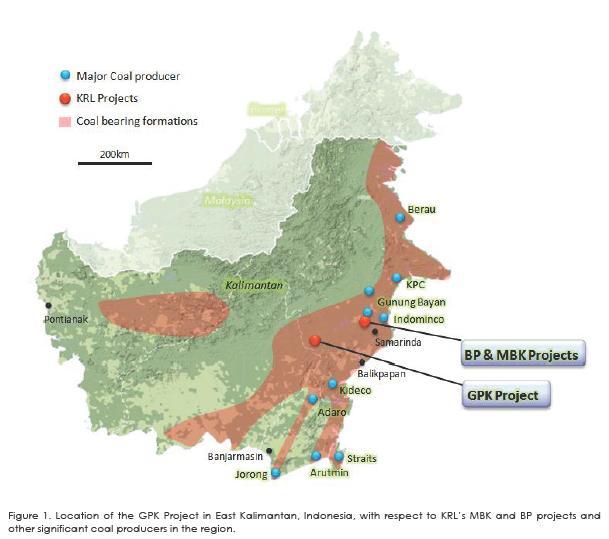

ASX-listed Kangaroo Resources Limited unveiled on Tuesday the results from the recently completed PT Graha Panca Karsa (GPK) coal concession drilling program in Indonesia?s East Kalimantan Province.
The company said in a statement that the drilling program in the Borrow-Use Forestry area (IPPKH) covering 467.5 Ha (total concession 5,060 Ha), which commenced in early 2017, was completed in July 2017 for a total of 42 holes and approximately 1,858 meters of drilling.
This program was designed to confirm continuity of coal seams which is sufficient to support future resource estimation. With the completion of this drill program, a total of 543 holes for a total of 12,529 meters have now been drilled on the GPK concession, the company said.
The company said two main seam groups have been identified in the GPK coal deposit, namely GRAHA (GRA) and TUKUL (TUK) which have an average vertical thickness of 4.4 meters and 1.3 m respectively. ?The results from the 2017 exploration program inside the IPPKH area confirmed the results of the previous exploration that the coal seams are continuous and retain similar coal quality characteristics,? Kangaroo said.
The project area is located within the Kutai Basin which was formed during the Late Eocene. Sedimentary infill in the Kutai Basin was sourced from the Schwanner Block and the Kuching Orogenic Complex which represented the Kalimantan mainland in the Tertiary. The Kutai Basin contains a vast thickness of alluvial and deltaic sediments of the Pamaluan, Pulubalang, Balikpapan and Kampung Baru formations, that prograde eastwards, and range in age from the Early Miocene to Pleistocene times. Deltaic deposition continues to the present day, and extends eastwards into the offshore Kutai Basin.
The GPK coal deposit occurs within the Middle Miocene age Balikpapan Formation which is dominated by quartz sandstone and claystone with intercalations of siltstone, shale, limestone and coal. The main structural features in the region are a succession of synclines and anticlines with northwest-southeast trending axial planes.
The deposit comprises a multiple-seam coal deposit located on a northwest-southeast trending syncline structure, gently plunging to the southeast. Strata dip is gentle, and ranges from 1 to 5 degrees with some of the area having an almost flat dip in the axis of the syncline. No faults were interpreted from the existing drill holes data in the concession area.
The company said seven minor seams with average vertical thickness ranging from 0.3 m to 1.2 m are also present above and below GRAHA and TUKUL seams within the concession. The geological data for those minor seams is limited and their continuity has not been established.
The 2017 exploration drilling program targeted coal seams to a maximum depth of 86 m, with drill holes spaced at 200-400 m along strike and down dip. However, the majority of the drill holes intersected the target coal seams at less than 50m depth. Some deep drill holes and geotechnical drill holes intersected the coal seams at up to 80m depth. A total of 39 holes in 2017 were cored holes with ?target cored? and ?full cored? methods and the coal recovery mostly exceed 90%. All recent drill holes are supported with geophysical log, except for two holes. All holes were drilled vertical with HQ core size (diameter 63.5 mm). All recent drill hole collars were surveyed using high accuracy Total Station equipment.
Coal samples from the 2017 exploration were collected from 39 drill holes and based on a ply by ply basis. The coal samples were sent to PT. Geoservices laboratory in Balikpapan for testing. PT. Geoservices is an independent accredited laboratory. Analysis methods use ASTM standards for TM, Proximate analysis, Total Sulphur, and CV. Some representative samples were also analyzed for RD, HGI, Ultimate analysis, Ash analysis, AFT, and EQM.
The coal is classified as sub-bituminous coal according to the ASTM Classification. The coal quality is characterized by low ash (average 5.0% adb), low total sulphur (average 0.15% adb), and an average Calorific Value (?CV?) of 3,870 kcal/kg gross as received (?gar?). No significant difference in coal quality results were identified both laterally and vertically. The comparison of coal quality results between previous and recent exploration are summarized in Table 1.
Table 1 ? Coal Quality Summary Comparison
| Coal Quality Parameter?? | Before 2011 | 2017 | Combined |
| Total Moisture (%, ar)
Inherent Moisture (%, adb) Ash (%, adb) Volatile Matter (%, adb) Fixed Carbon (%, adb) Sulphur (%, adb) Calorific Value (kcal/kg, gar) Relative Density (g/cc) |
38.8
18.7 5.1 40.7 35.5 0.16 3,920 1.34 |
38.8
17.1 5.0 41.5 36.5 0.14 3,935 1.35 |
38.8
17.5 5.0 41.3 36.2 0.15 3,930 1.35 |
| Note: the coal quality value was based on all coal samples and thickness weighted average | |||
An adjacent third-party coal mine has constructed a haul road to the Mahakam River that crosses the GPK concession. Stockpiling, crushing and barge loading facilities have also been constructed by the third party. GPK has already acquired its own land for stockpiling, crushing and barge loading facilities on the riverfront however there is potential to cooperate with the third party on the joint usage of the haul road.
The information in this Report that relates to the Exploration Results of the GPK Deposit is based on, and fairly represents, information and supporting documentation prepared by Mr. Oki Wijayanto who is a Member of the Australasian Institute of Mining and Metallurgy. Mr Oki Wijayanto is a full time employee of the PT RungePincockMinarco. Mr Oki Wijayanto has sufficient experience which is relevant to the style of mineralization and type of deposit under consideration and to the activity which he has undertaken to qualify as a Competent Person as defined in the 2012 Edition of the ?Australasian Code for the Reporting of Exploration Results, Mineral Resources and Ore Reserves?. Oki Wijayanto consents to the inclusion in this report of the matters based on this information in the form and context in which it appears.
Editing by Reiner Simanjuntak