

PJB, Masdar sign agreement on world?s largest floating solar PV
Wednesday, November 29 2017 - 01:03 AM WIB
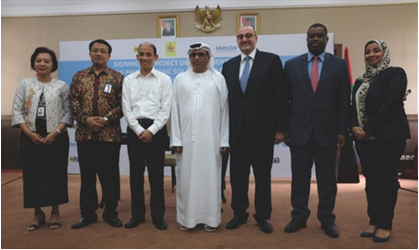

Power producer PT Pembangkitan Jawa-Bali (PJB), a subsidiary of Indonesia?s state-owned electricity firm PLN, and United Arab Emirates? Masdar signed on Tuesday a project development agreement (PDA) for the world?s largest floating solar photovoltaic (PV) power plant.
With a capacity of 200 MW, the plant will cover an area of 225 hectares atop the Cirata Reservoir in the West Java province of Indonesia. The 6,000-hectare Cirata Reservoir already powers a 1GW hydroelectric power station.
The PDA was signed by PJB President Director Iwan Agung Firstantara, and Mohamed Jameel Al Ramahi, Chief Executive Officer of Masdar, witnessed among others by Deputy Minister of Energy and Mineral Resources Arcandra Tahar.
Iwan told reporters that the power purchase agreement (PPA) is expected to be signed in January of 2018 with PLN. He said that price of the electricity from the planned power plant is still being negotiated, but it will not exceed the local electricity supply cost (BPP) of PLN as set under the current regulation.
He said that the first phase of the floating solar power plant, with capacity of 50 MW, is targeted to start commercial operation in the second quarter of 2019, while the capacity of 150 MW in the first quarter of 2020.
?We believe this project development agreement is a milestone in the development of other floating PV solar power plants; this 200MW project will be the largest project of its kind in Indonesia and PJB-Masdar will be a pioneer of floating PV technology. Inshallah, developing this project will be a great success and a proud achievement for Indonesia,? Iwan said separately in a statement.
?Today?s signing marks the entry of Masdar into South East Asia and our first project in floating solar power,? said Al Ramahi, CEO of Masdar. ?The agreement with PT PJB for the world?s largest floating solar power plant demonstrates Masdar?s ambition as a global renewable energy leader and the strength of our industry partnerships.?
One of the advantages of floating solar power in tropical countries like Indonesia is that it enables renewable energy development in forested regions generally unsuitable for conventional solar power. The successful deployment of the Cirata project paves the way for the installation of floating solar power on another 60 reservoirs across Indonesia.
The planned 200MW floating PV project will be mounted on 700,000 floats moored to the bed of the Cirata reservoir and connected by electrical cables to an onshore high-voltage substation. Besides producing clean power, the facility will provide shading against the sun, reducing evaporation from the reservoir and limiting the growth of algae.
The PDA signing follows the agreement of an MoU between PJB and Masdar in July this year to collaborate on finding sustainable solutions to Indonesia?s rapidly growing energy demand, with a focus on projects in the Java-Bali and Sumatra regions.
According to the International Renewable Energy Agency (IRENA), the country has the potential to produce more than 700 gigawatts (GW) of renewable energy, including 532.6 gigawatts of solar power.
Since 2006, Masdar has invested in renewable energy projects with a combined value of US$8.5 billion; the company?s share of this investment is $2.7 billion. Masdar commercializes advanced technologies by deploying them at scale. Examples include Hywind Scotland, the world?s first utility-scale offshore wind farm; Gemasolar in Spain, the first solar thermal power plant producing electricity 24 hours a day; and London Array, currently the world?s largest offshore wind farm in operation.
Last year, a Masdar-led consortium was appointed to build the 800MW third phase of the Mohamed Bin Rashid Al Maktoum Solar Park in Dubai, quoting a record low price for solar power generation. Masdar will be showcasing its global renewable energy project portfolio at Abu Dhabi Sustainability Week, taking place from January 13-20.
Editing by Reiner Simanjuntak