

Regional CCS: Korea’s Donghae-1 moves into design phase
Wednesday, December 10 2025 - 12:44 PM WIB
By Raymond Hendriawan
Korea National Oil Corporation (KNOC) is advancing plans to convert the depleted Donghae-1 gas field into the country’s first large-scale carbon capture and storage (CCS) project, forming the core of a three-track strategy that includes domestic storage development and cross-border CCS cooperation with Indonesia.
Speaking at the Carbon Digital Conference (CDC) 2025 in Bandung, Woochan Lee, CCS team manager at KNOC, said the Donghae CCS project is essential to meeting South Korea’s Nationally Determined Contribution (NDC) targets, which call for 4.8 million tonnes per year of CO₂ to be stored through CCS by 2030 and 11.2–20.3 million tonnes per year through CCUS by 2035. KNOC plans to meet these goals through three channels: the 1.2 Mtpa Donghae CCS hub, additional domestic storage sites, and cross-border CCS using overseas storage capacity.
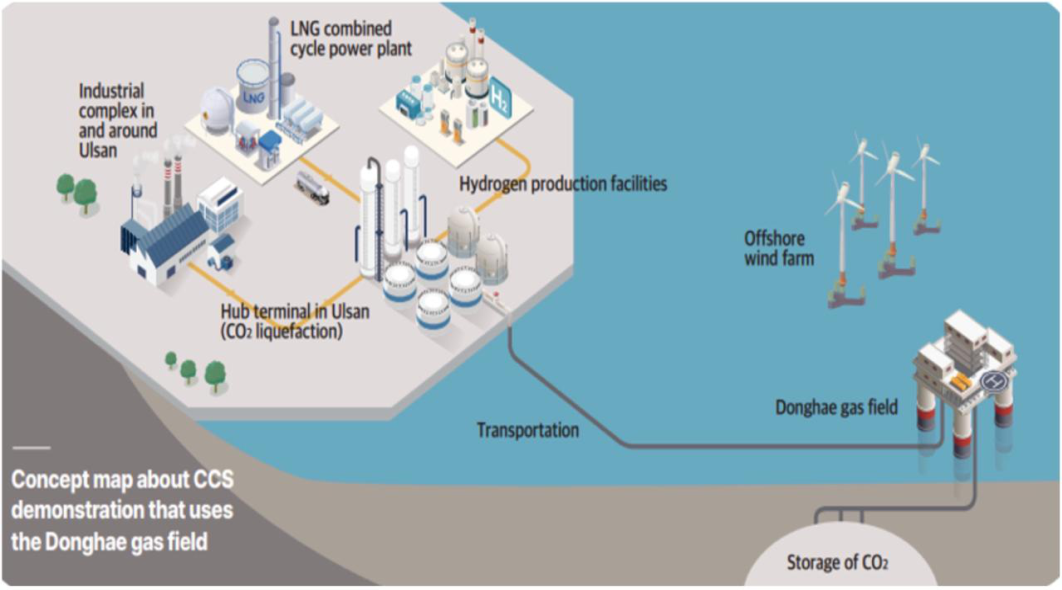
Donghae-1, located in the East Sea offshore Ulsan, ended gas production in 2021, making the depleted reservoir available for CO₂ storage. KNOC and the Korean government selected it for a 1.2 Mtpa demonstration project that will repurpose the existing offshore platform and construct a new CO₂ pipeline from onshore industrial emitters.
Read also : KNOC, Bakrie among suitors for Tuna block stake
Lee outlined a three-phase development roadmap:
• Phase 1 (2021–2024): Completed. Covered detailed site assessment, a pre-FEED program, and the establishment of the CCUS Act and related regulations governing permitting, liability and monitoring.
• Phase 2 (to around 2030): Now underway. Includes full FEED, EPC contracting, modification of the Donghae-1 platform and installation of the offshore CO₂ pipeline. The demonstration is designed to capture and store 1.2 Mtpa of CO₂ from domestic industrial complexes, with first injection targeted before the end of the decade.
• Phase 3 (to 2060): Will focus on long-term CO₂ injection, MRV (monitoring, reporting and verification), and stepwise expansion of the storage hub as additional emitters are connected.
Beyond the demonstration phase, KNOC plans a broader storage expansion between 2040 and 2060. This will include drilling new injection and appraisal wells to reduce uncertainty over caprock extent, validate pressure behavior, and refine the estimated storage capacity, which KNOC currently places at up to 170 million tonnes of CO₂ for the Donghae area.
Lee emphasized that Donghae CCS is only one part of KNOC’s wider CCS strategy. On Korea’s west coast, at Daesan, the company is developing a cross-border CCS chain that would transport CO₂ from industrial clusters to offshore storage hubs in Indonesia.
He highlighted several milestones already achieved: an MoU signed in September 2023 between KNOC and Pertamina on CCS and oil and gas cooperation; a Framework Agreement signed in May 2024 by KNOC, Pertamina and ExxonMobil on Korea–Indonesia cross-border CCS focused on a hub in the Sunda-Asri basins; and a Joint Study Agreement signed in September 2024 between KNOC, ExxonMobil, Hyundai E&C and Hyundai Steel to advance the cross-border CCS concept and cluster development around Daesan.
Under these agreements, Pertamina and ExxonMobil are leading evaluation of an offshore CCS hub in the Sunda-Asri area, while KNOC is positioned as a key user of the storage capacity, channeling captured CO₂ from Korean industrial facilities to Indonesia.
Editing by Reiner Simanjuntak