

RELEASE: Kalimantan Gold's Baroi produces some high-grade drill results
Thursday, February 12 2004 - 06:30 AM WIB

Rahman Connelly, CEO commented, 'Whilst only 12 scout holes were planned we did 10 additional ones as a result of the encouraging geology and mineralization found in the early holes. In addition Airborne Magnetic and other aerial data has been re-evaluated, SWIR spectral and PIMA analysis has been undertaken and samples analysed to determine background geochemical values. All this information was reviewed on site in late January by an internationally recognized copper gold porphyry expert, Mr. Terry Leach, with the objective of precisely defining targets for the six 300 meter holes.' Mr Leach's detailed report will be available on the KGC web site in the near future.
Discussion of Scout Drill Program
The exploratory diamond drill holes were drilled in NQ and BQ drill core size, to a maximum depth of 85 meters and were all inclined at 60 degrees. These holes have been drilled over an area of 900 meters east-west and 1800 meters north-south to test a variety of geological targets in what is otherwise difficult-to-sample terrain. These targets include:
a) Diatreme breccia - holes BF -1, BF-22
b) Gossanous silica zones - BF -4, -6, -7, -8, -10 &-11
c) High grade vein outcrops - BF -2, -3, -5, -9, -18, -19, -20
d) Silica sand area - BF -12, -13
e) Dacite porphyry and advanced argillic alteration - BF -14, BF-21
f) South-east area near contact with granodiorite pluton - BF -15, BF -16
g) Intense phyllic alteration to the south-west: BF -17
The Company is most encouraged with the results and findings of this exploratory drill program. As the program was intended as a geological exercise, only drill core displaying significant mineralization was selected for geochemical analysis. A detailed list of all drill holes showing locations is attached at the end of this release.
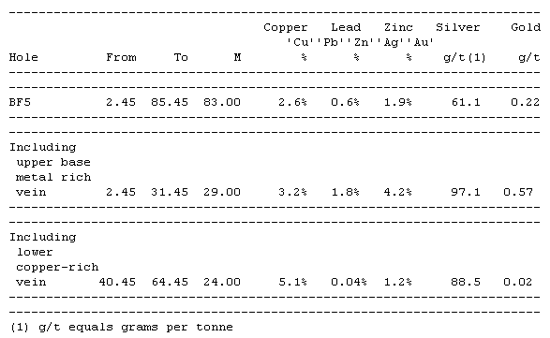
High grade copper zinc, lead, silver and gold were intersected in a number of holes. The drill hole BF-5 mineralization is hosted in veins that occur within a 200 meters wide south-east trending zone that extends 4-5 kilometres north west to the Central Zone. This massive mineralization is interpreted to be the result of mineral rich fluids migrating from a shallow porphyry intrusion through zones of strong structural dilation at the FEZ.
Other significant intercepts from the holes assayed in this shallow hole drilling program are as follows.

At the time of writing assay results for drill holes BF-17 through BF-22 are pending.
Diatreme-like breccias were intersected in drill holes BF-14, BF-21 and to a lesser extent BF-8 in the southern part of the project area. The presence of porphyry intrusion, silicified and sulphide clasts in these breccias, increases the potential for an economic porphyry system in the south and west part of the FEZ. This is supported by the intersection of extensive phyllic alteration in BF-17, and moderate phyllic alteration in bottom hole BF-12, -13 and BF-14.
Drill hole BF-22 also intercepted a clay supported matrix diatreme breccia, with clasts of mineralized porphyry, silisified rocks and quartz veins containing chalcopyrite, in the northern part of the project area. The hole was terminated at 45 meters, as the small drill rig was not capable of penetrating further into the diatreme. This hole has provided further strong evidence of an underlying mineralized copper gold porphyry system at the FEZ.
A conceptual model incorporating surface geology and data, plus the results from the scout drilling program has been developed for the Baroi Far East Zone.
This model suggests that the high grade quartz sulphide veins occur as dilational jogs within the major SE structural zone. These exceptionally dilated zones are most likely the result of a mineral rich porphyry intrusion at depth in the southwest portion of the FEZ, where intense phyllic alteration has been identified in drill hole BF 17. The presence of a diatreme breccia and advanced argillic alteration in drill hole BF 14 and BF21 also supports this model.
Additional work undertaken
In addition to drilling, KGC has conducted several other exploration activities during the past 3 months, which have provided information vectors on the FEZ prospect. These include:
- The collection and analysis of 425 rock and drill core samples using SWIR spectral analysis or PIMA.
- The systematic collection and analysis of 65 host rock or non vein channels samples is an attempt to determine background geochemical valves at the prospects.
- The re-evaluation and interpretation of Airborne Magnetic data over the entire Contract of Work, with specific attention to the Baroi prospect.
- The interpretation of aerial photographs Landsat ETM and radarsat imagery over the entire CoW, with specific attention to the Baroi prospect.
As a result of this work, KGC has commenced exploration activities in an area 5 kilometers south east and down strike from the FEZ, where porphyry signatures have been identified.
Objectives of 300 meter hole program
The ongoing drilling program will utilize the Company's man portable RB34 drill rig capable of depths to 300 meters. This program is designed to test:
- The potential for a high grade low tonnage massive sulphide orebody in a similar setting, and possibly a deeper extension, to that intersected by BF -5.
- The potential for a mineralized porphyry at shallow levels in the south-west part of the FEZ.
- The source of copper mineralization associated with quartz veins in the northern diatreme breccia.
The Government of Indonesia through the Governor of Central Kalimantan has granted KGC a 5,000 hectare expansion to the KSK Contract of Work bringing the size to 129,300 hectares. KGC has also received written assurance from the Governor of Central Kalimantan that the government will fully support the Company rights under the KSK CoW to explore and mine within a protected forest area. KGC holds a 75% interest in the KSK CoW.
Presently a team of 35 men is on site at the FEZ and a camp expansion is underway to accommodate up to 100 personnel.
KGC has established quality assurance procedures for sampling and assays. This includes duplicate and re-assay checks of samples with PT Intertek Utama Services, Jakarta, an internationally recognized Lab other than that normally used, PT Indoassay Laboratories, Balikpapan. All data disclosed, including sampling, analytical and test data in this press release have been verified by the Company's Qualified Person, Mr. Didik Prasetyo, senior project geologist. A detailed list and map of all drill hole locations drilled to date is attached. (end of release)
To view the attached map please click on the following link: http://www2.cdn-news.com/database/fax/2000/klg0211.jpg
Kalimantan Gold Corporation Limited Doris Meyer Corporate Secretary (604) 516-0566 (604) 516-0568 (FAX) Email: info@kalimantan.com Website: www.kalimantan.com