

Uncertainties linger over new gross split policy
Monday, September 11 2017 - 12:50 AM WIB

Petromindo|Thomas
While the oil and gas industry players generally welcome the government?s newly revised gross split policy, they are still concerned with a number of lingering uncertainties in the policy and expect the government to quickly address the issues.
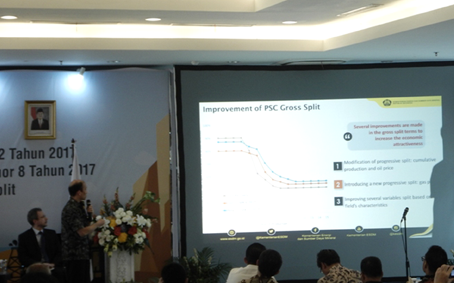
During a discussion forum on Friday led by Deputy Minister of Energy and Mineral Resources Arcandra Tahar to explain about the new policy, industry players questioned the tax mechanism in the gross split policy.
President of Indonesian Petroleum Association (IPA) Christina Verchere said that while the revised gross split policy is expected to provide a ?fresh air? for investment in the country?s upstream sector, the government must provide clarity over the tax issue as the oil and gas output split of contractors are subject to tax.
She said that lingering uncertainty over the tax mechanism could undermine the government?s efforts to improve the economic feasibility of upstream projects through the additional split for contractors as set out in the revised gross split policy. She urged the government to provide clarity over the taxation mechanism and warned government from creating new uncertainty which would run counter against the positive performance so far in revising the gross split policy.
While oil and gas contractors welcome the newly revised gross split policy, which no longer limits the energy minister?s discretion in providing additional output split for contractors, they also questioned the uncertainty regarding factors affecting the minister?s discretion.
Participants in the Friday discussion also questioned whether there will be a higher form of regulation than the current ministerial regulation governing the new gross split policy as they feared that the policy may change in the future when minister changes.
Minister of Energy and Mineral Resources Ignasius Jonan has recently issued new Ministerial Regulation No 52/2017 on the revision of Ministerial Regulation No 8/2017 regarding gross split oil and gas production sharing contract, among others promising additional incentives for oil and gas contractors including during exploration phase.
Upstream oil and gas regulator SKK Migas Chairman Amien Sunaryadi said last week that he is optimistic that the revised gross split policy will attract fresh investment in the country?s upstream oil and gas sector.
Amien said that growing number of oil and gas contractors will apply the gross split mechanism through 2025. He said that this year, there will be up to 10 new production sharing contracts that will apply the gross split mechanism. ?We hope that this year, there will be more contractors applying the gross split scheme, about 5-10 contracts, and there will be more through 2025,? he said, adding that until 2025, a total of 33 contracts which will switch from cost recovery mechanism to gross split mechanism.
The government introduced earlier this year the new gross split policy, to replace the existing cost recovery mechanism. Under the new policy, the government will no longer reimburse the investment and operating costs of the contractors. In return, the contractors will get a higher production split. The new policy will be applied initially in new oil and gas contracts. PHE ONWJ was the first to apply the gross split mechanism in its contract over the ONWJ block, offshore West Java, when it was renewed by the government in January.
But many oil and gas contractors initially opposed the new policy saying it would undermine the economics of upstream projects in the country. This prompted Minister of Energy and Mineral Resources Ignasius Jonan to revise the policy and recently introduced a new Ministerial Regulation No 52/2017, which among others promise additional incentives for the contractors including extra output split. (*)