

E. Java?s Brantas PSC profile update
Thursday, January 22 2004 - 05:58 AM WIB
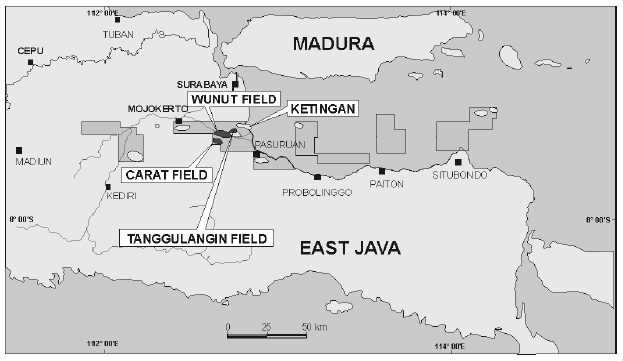
Permit: Brantas
Status: Production, Exploration
Novus?s Interest: 50%
Other Interest Holders: Lapindo Brantas (50% & operator)
Novus?s interests in Indonesia are held through a PSC. The PSC is an agreement that sets out the basis for contractors operating petroleum licence areas in Indonesia. Under the terms of PSCs in Indonesia, contractors are entitled to take 80% of all hydrocarbon production until all accumulated historical costs are recovered, with the 20% balance set aside for profit sharing (Profit Oil). After recovery of historical costs all production is treated as Profit Oil. The Indonesian government generally takes 85% of all oil production and 30% of all gas production inclusive of tax. In addition, contractors are obliged to supply 25% of their share of oil production after cost recovery into the domestic market at a fixed price pursuant to a domestic market obligation.
PROFILE OF BRANTAS

Novus has a 50% interest in the Brantas PSC which covers an area of approximately 3,000 km2 in onshore East Java and offshore Madura Strait, between East Java and Madura Island. Novus initially acquired a 40% non-operating interest in Brantas in 1995. In 1996, the joint venture was restructured and a new 50/50 joint venture was created with Lapindo Brantas, Inc., the operator of the field.
Production is from the Wunut gas field in the central part of the block, located 30 kilometres south of Surabaya. The Wunut field was discovered in 1994 and has been producing since 1999. In late 2001, a discovery was made at Tanggulangin, approximately eight kilometers east of the Wunut facilities. A discovery was made with the next well at Carat, which is located six kilometres south of Wunut. The third well of the program, Grati 1, encountered uneconomic gas shows.
An agreement has been signed with PT Perusahaan Gas Negara, the Indonesian natural gas distributor, for the supply of up to 80 MMscfd of gas on a reasonable endeavours basis through to the end of 2007. A development drilling program recommenced in December 2003, together with plant expansions that will provide plant capacity of over 100 MMscfd. In the fourth quarter of 2003, production increased for the eighth consecutive quarter, peaking at 64 MMscfd and averaging 54 MMscfd for the quarter.
The following table sets out Novus?s interest in the Brantas PSC reserves as at 31 December 2003:

The total production for the Brantas PSC for the three years ended 31 December 2003 is set out in the following table:

VALUATION OF BRANTAS
A value in the range US$70-90 million has been attributed to Novus?s 50% interest in the Brantas field. The value comprises Grant Samuel?s valuation of Novus?s producing assets at Brantas of US$65-75 million and Gaffney Cline?s valuation of Novus?s exploration interests of US$5-15 million.
Novus announced in July 2003 that the Brantas PSC participants had signed a ?Principles of Gas Supply Agreement? with PGN, the Indonesian national gas distributor, whereby the Brantas PSC participants will supply up to 80 MMscfd on a reasonable endeavours basis until the end of 2007. A final Gas Sales Agreement was concluded with PGN in December 2003.
Production from Brantas has increased for the last eight consecutive quarters, averaging 54 MMscfd for the fourth quarter of 2003, reflecting strong performance from the Wunut field. A drilling campaign commenced at Brantas in mid-December 2003, consisting of three wells into the Wunut field and a well aimed at further appraising the Tanggulangin discovery.
Two scenarios were developed to assess the value of Novus?s interest in the producing assets at the Brantas field. They reflect likely production profiles over an expected remaining field life of 11-12 years. The scenarios used in the analysis were as follows:
? Scenario 1:
Scenario 1 is based on total production of 188 bcf of natural gas over the remaining life of the field. The total life of the field is projected to be 11 years. Production for the five years to 31 December 2008 averages around 75 MMscfd. Field operating costs for the five year period are in the range US$0.27-0.36/Mcfe. Total capital costs for the remaining life of the field are US$59 million, based on the drilling of 12 additional gas wells, one of which is currently being drilled.
? Scenario 2:
Scenario 2 assumes improved field performance. As a result, a total of 244 bcf of natural gas and 7 MMbbl of oil is produced over the remaining life of the field. The total remaining life of the field is projected to be 12 years. Production for the five years to 31 December 2008 averages around 85 MMscfd. Field operating costs for the five year period are in the range US$0.21-0.26/Mcfe. Total capital costs for the life of the field are US$82 million, based on the drilling of 12 additional gas wells and 6 oil wells.
The price currently realised for gas sales from Brantas is based on a negotiated rate per Mmbtu of gas supplied through to the end of 2007. For commercial reasons, Novus has requested that Grant Samuel not disclose the detailed terms of the contractual arrangements for the Brantas field.
For the purposes of the DCF analysis, Grant Samuel has analysed both a low price case (price realised past 2007 is 95% of current agreed price) and a high price case (price realised past 2007 is 105% of current agreed price). The results of the NPV analysis for the Brantas field, based on the low and high price cases and a range of discount rates, are set out below:

Grant Samuel has assessed the value of Novus?s production interests at Brantas field in the range US$65-75 million, which reflects the DCF analysis and a subjective assessment of Gaffney Cline has valued Novus?s exploration interests at Brantas in the range of
US$5-15 million, which is not reflected in the DCF values above. Gaffney Cline?s valuation of these exploration interests is set out to this report.
INDEPENDENT TECHNICAL SPECIALIST?S REPORT ON THE PETROLEUM ASSETS OF NOVUS PETROLEUM LIMITED
This report has been prepared independently by Gaffney, Cline & Associates (GCA) with due regard to the Valmin Code issued by the Australasian Institute of Mining and Metallurgy. It will be appreciated that GCA has neither sought nor received any relevant third-party authorizations that may be necessary for the information provided herein to be entered into the public domain.
ASSET DESCRIPTIONS
The Brantas PSC is located in East Java, both onshore and offshore. The PSC covers an area of about 3,050 sq km and expires in 2020. The asset of primary interest within the Brantas PSC is the Wunut gas field located onshore in the central portion of the block 30 km south of the major city of Surabaya. The block is well placed to provide gas into an East Java market with customers including the Indonesian utility company PGN, and local power plants.
PRODUCING ASSETS
The Wunut Field was discovered in 1994 and successfully appraised in 1995. A plan of development (POD) was approved by Pertamina in early 1996 and a gas sales agreement was executed between Lapindo (on behalf of BPMigas, itself and Novus) and PGN in 2003.
The originally planned development proposed using two existing gas wells and nine new wells with production to commence in late 1998. The drilling of development wells commenced in January 1998. However, after development had commenced, a downturn in the Indonesian economy resulted in a reduced demand for gas in the East Java market. A downscaled development continued, but expanded again once the sales agreement was signed. Currently there are 11 wells on line, one currently drilling and 4 more planned for 2004.
Gas production commenced in January 1999 and has increased sharply in the last 2 years, reaching almost 65 MMscfd in November, 2003. The plant capacity is currently being increased to over 100 MMscfd. The PGN contract is for volumes of up to 80 MMscfd, through to 2007. The field produces from 15 sandstone reservoirs of Plio-Pleistocene age which are located at a relatively shallow depth of between 500 - 800 m and contained in a simple anticlinal closure. The field is covered by a 1 x 1.5 km grid of 2D seismic data which appears to be adequate to map the simple structure. Reserve estimates have recently been provided by a local consulting company, which provide support, based on a volumetric approach, for Scenario 2. However, there remains a discrepancy between the volumetric analysis and material balance analysis. For Scenario 1, therefore, GCA has relied on the more conservative material balance approach.
Production and cost forecasts have been developed for Wunut plus the two recent discoveries at Tanggulangin and Carat, which are discussed in the following section. The forecasts are covered below.
NON-PRODUCING ASSETS
Recent exploration drilling resulted in two discoveries and one dry hole.
Tanggulangin Field
The Tanggulangin Field was discovered in November 2001 and successfully appraised by a second well in February 2003. The second well was completed as a future gas producer and a third well is planned for early 2004. Like Wunut, the structure is an anticlinal closure with reservoirs of Plio-Pleistocene age. Development is expected to be by trunkline into the Wunut facilities.
Carat Field
Carat-1 was drilled in 2002 and produced gas from one of the same sands seen at Wunut and Tanggulangin. A further well is planned in 2004 and, like the Tanggulangin Field, is expected to be developed via a trunk-line into the Wunut facilities.
BRANTAS FORECASTS
Scenario 1 is based on the continued development of the Wunut Field during 2004 and the assumption that further gas sales agreements will be secured that maintain demand at the currently contracted level of 80 MMscfd. As mentioned above, material balance estimate of reserves was the basis for this case. In addition to the drilling scheduled for 2004, seven further wells are expected to be required in 2005 and 2006 to maintain deliverability.
Scenario 2 reflects a more optimistic view of the local market for gas, as supported by the view of the Operator with the upgrading of the facilities. For this case, the limit was set at 100 MMscfd. Reserves for Wunut were based on the more optimistic volumetric analysis, as supported by the recent independent study, and the same level of capital investment. The possible development of the oil found at Tanggulangin (estimated to require 6 wells in 2005) was also included in this case.


EXPLORATION POTENTIAL
The 2004 work programme includes seven exploration wells, of which three will be offshore. In addition, two wells are scheduled for West Wunut, a potential extension of the Wunut Field based on an interpretation by the Operator of stratigraphic trapping. This potential is classified by GCA as an exploration target, and valued accordingly. The onshore prospects are either targeted at the same play as proven by the existing discoveries or at deeper Miocene carbonate build-ups that can be identified on seismic data. The latter targets are of significantly higher risk than the clastic play, as one such build-up was drilled and found to be dry, though it appeared to have been breached by a fault. Prospect sizes are generally assessed by GCA to be comparable to Wunut, i.e. 100-200 Bscf (gross, unrisked).
Offshore, the three prospects are shallow gas targets, mapped in compressional structures that have been proved productive in the area by nearby discoveries (e.g. the Maleo gas discovery). There are seismic anomalies that support the presence of gas in two of the prospects, reducing the risk. The offshore prospects have the potential to be somewhat larger than the onshore prospects at 200-500 Bscf (gross, unrisked).
The Operator has identified a significant number of further prospects and leads in the area that could be provide additional upside should the 2004 exploration programme demonstrate continued success. No value has been ascribed to this additional potential.
EXPLORATION VALUATION
GCA undertook an EMV analysis of the seven exploration targets plus West Wunut and has estimated that the value of Novus?s exploration interests in the Brantas PSC described above lies in the range US$ 5MM to US$ 15MM. (end of profile)