

OPINION: Indonesian Coal: Domestic Demand and Supply - By: Alastair Grant and Ario Suyudanto (Part 1)
Tuesday, June 7 2005 - 02:02 AM WIB
Editor?s note: This paper, which is divided into two parts for readers? convenience, appears on Petromindo.Com with Mr. Alastair Grant?s permission.
Introduction
The domestic use of coal in Indonesia goes back a number of centuries as coal extracted from outcrops was used as a fuel source in many regions. The start of the nation?s first coal mining operations in 1849 was essentially to supply a domestic market including railways and steamships.
Domestic demand was the basis for Indonesia?s coal industry for the next century but the ready availability of oil at low prices from the 1950?s meant domestic demand fell away from that time and so therefore did the coal industry.
The first oil crisis of 1973/74 led to a revival of domestic demand for coal and a Presidential instruction was issued in 1976 directing the ministers of Industry and Public Works to give priority to the use of coal for heat generation in thermal power plants and industry in order to conserve the country?s oil reserves. This Presidential instruction was the beginning of a national energy policy which has energy diversification as one of its major aims, and has led to a large scale revival of domestic coal demand.
In line with this energy policy the Government proceeded with the development of large scale coal fired plants, the first being at Suralaya, West Java, with the initial 400 MW unit of what is now a 3,400 MW coal fired plant complex, being commissioned in 1984. Development of the Paiton coal fired power plant complex followed with start up of the first unit in 1994. Equally importantly private and foreign investment in coal fired power plants was allowed and the first major independent power producer, PT Paiton Energy, started operations in 1998 followed soon after by PT Jawa Power.
Private coal fired power plants were also developed for mining operations, at Freeport and Newmont?s Batu Hijau mines, and for pulp and paper industries. Mine mouth coal fired plants were built at Ombilin, Bukit Asam and Kaltim Prima.
Of significance for domestic coal demand was the switch of the cement industry to coal as a fuel. This switch was a result of lower energy prices from coal, reliability of supply from the growing Indonesian coal industry, and a wide range of coal suppliers ensuring a competitive market.
A current growth market is the domestic use of coal in a range of industries, notably in Java. These industries include pulp and paper, limestone, textiles, sugar processing and manufacturing. The high price of oil, and the projected higher prices as the Government removes fuel subsidies, has led to older industrial plants converting to coal use and many new plants being based on coal as a fuel.
Coal therefore has been an important part of energy supply for domestic use and the domestic coal market growth in both absolute and relative terms appears assured given the continuing growth of Indonesian coal supply.
Domestic Coal Demand
Overview
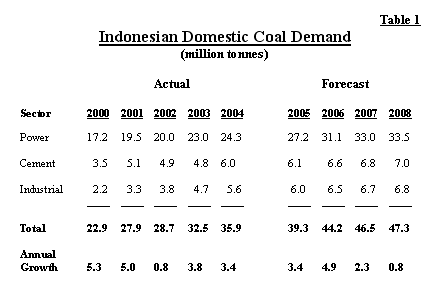
Indonesia?s domestic coal demand has grown in the last five years from an estimated 22.9 million tonnes in 2000 to 35.9 million tonnes in 2004 (Table 1). This is an increase of 13 million tonnes in that period and the demand growth has averaged 3.7 million tonnes a year.
Coal fired power plants are the major domestic coal users and last year, 2004, were about 68% of the domestic coal market. This is down from the 75% of the market they represented in 2000, mainly because of the growth of the industrial market for coal in that period and no new coal fired power plants. This situation is likely to be reversed from 2005 with new coal fired power plants starting up and limited industrial growth.
Essentially all of the domestic coal demand is met by domestic supply. Given the growth of the Indonesian coal industry it is unlikely that coal will be imported for domestic use in the foreseeable future.
Power
Historical Background
The growth of the use of coal as a primary fuel in Indonesia?s energy mix was triggered by the oil shocks of the 1970?s. Policies were adopted putting priority on the use of Indonesia?s oil reserves for export while harnessing the country?s coal deposits for domestic power generation and industrial energy use, and also as a source of export earnings.
The first major domestic coal fired power plant developed on these policies was the generating complex at Suralaya in West Java. The first block of 2 x 400 MW units commenced commercial operations in 1985 followed by the second block of 2 x 400 MW units in 1990. A further 3 x 600 MW units were built in the 1990?s. Associated with this was the rehabilitation and expansion

of state owned mines in the Bukit Asam area of South Sumatra, developed as part of the World Bank funded project. The mine and the power plant were linked by a coal transportation system involving a railway, a port and specialized self unloading vessels.
The start up of a large coal mines in Kalimantan was the catalyst for development by PLN of a further coal fired power station complex at Paiton in East Java. The first units at Paiton, the 2 x 400 MW units of PLN, commenced commercial operations in 1994.
The Rise of Independent Power Producers
By 1990 the Government had recognized that because of the country?s rapid growth, electricity demand would outstrip PLN?s financial capacity to construct new power plants. The power generating industry was deregulated to allow private developers to submit proposals for privately financed development of power stations.
Initially PLN gave priority to the private development of the four coal fired 600 MW units at Paiton and the green fields development of another major coal fired complex at Tanjung Jati, Central Java. These were to complete the base load plan for the Java-Bali grid and the projects were among the first to be negotiated by PLN.
Industrial growth continued to accelerate rapidly from 1992 to 1996 and to meet the forecast associated rise in power demand, the Government opened up additional projects for private development. By 1996 the PLN had signed or was negotiating power purchase agreements for development of eleven coal fired power stations with a total installed capacity of 7,180 MW (Table 2).
During this same period the rise in coal production had mirrored industrial growth with annual production increases of up to 30% being achieved. By 1996 total coal production had reached 50 millions tonnes with further increases forecast for well beyond 2000. It was this coal production growth that provided the fuel supply security to the coal fired power projects. A total of 25 million tonnes per year was committed under long term contracts by Kalimantan coal producers to new power stations. This was in addition to the 14.5 million tonnes that was already being supplied to the PLN units at Suralaya and Paiton.

The Impact of The Financial Crisis
Immediately following the financial crisis of 1997/1998 electricity demand plunged dramatically as industry was forced into massive cutbacks in output. PLN put nearly all of the private power developments on hold with the exception of the two projects at Paiton which were well into their construction phase.
These two projects were completed in 1998 and 1999 adding 2,450 MW to PLN?s generating capacity. However, due to the financial difficulties that PLN was facing at that time, plus lack of demand, neither of these could commence commercial operations and were put on standby status.
In 2000 Indonesia started to experience positive growth rates again together with the first increase in power demand since the crisis and, after preliminary renegotiation of the tariff structure, both the Paiton private power stations commenced commercial operations at reduced levels. Output from these stations, together with PLN?s total generating capacity, has increased steadily since that time as the economy has recovered and demand has continued to rise.
In direct contrast to the contraction in electricity demand during the crisis years after 1997, the country?s coal industry continued to expand rapidly because of rising global demand, in particular for Indonesia?s environmentally clean sub-bituminous coals. By 2001 coal production had reached 96 million tonnes with 78 million tonnes being exported. The balance of 28 million tonnes was being supplied to the domestic market of which nearly 20 million tonnes was for power generating capacity.
Current Coal Fired Power Plants
As at 2003, PLN?s exiting generation capacity was 21,206 MW consisting of coal, natural gas, geothermal, hydro and oil power plants. In addition there are seven independent power producers with a total capacity of 3,010 MW giving a combined generating capacity of 24,216 MW.
The coal fired power plants currently operating in Indonesia, or under construction, are shown in Table 3.
Of the three new coal fired plants under construction both Tanjung Jati B and Cilacap are scheduled to start up in 2005 with commercial operations in 2006.

The Tanjung Kasam plant in Batam is expected to start taking coal later in 2007.
Future Coal Requirements
In recent studies PLN has forecast that electricity growth rate will be 6% - 7% per year to 2010 with energy consumption in 2010 being double that of the year 2000. Growth in the primary energy mix for the power sector will continue to be dominated by coal with coal fired plants forecast to be generating 58% of domestic electricity production in the year 2010.
In order to meet the future power demand growth the Indonesian Government included 9 coal fired power plants among the 91 projects offered to private investors at an infrastructure development meeting held in Jakarta in January this year. Most these power plants had been previously being planned, and in the case of Tanjung Jati B being developed, as IPP?s before the currency crisis of 1997/1998 caused their cancellation.
The power plants that were offered, are shown in Table 4 together with the planned Tarahan and Makassar plants. The largest coal fired power plants are all planned for the island of Java. Two of these are at the Tanjung Jati complex, one is at the last site available at the Paiton complex and two other large plants are to be sited in Banten.
However all of these projects are still in the planning stage and the earliest that new plants could start would be in 2009. The first start up could be Tanjung Jati A, for which coal supply sourcing has started, or one of the smaller plants outside Java.
The projected power station coal consumption in Indonesia till 2008 is shown in Table 5. Coal demand in 2005 could be over 27 million tonnes, increasing to 31 million tonnes in 2006 as the new plants go to full capacity, and then be relatively flat in 2007 and 2008. Coal demand could start to grow again in 2009 and increase significantly from 2010 (Figure 2) as another new generation of coal fired power plants start up to meet Indonesia?s electricity demand growth.


