

OPINION: Indonesian Coal: Domestic Demand and Supply - By: Alastair Grant and Ario Suyudanto (Part 2)
Tuesday, June 7 2005 - 02:06 AM WIB
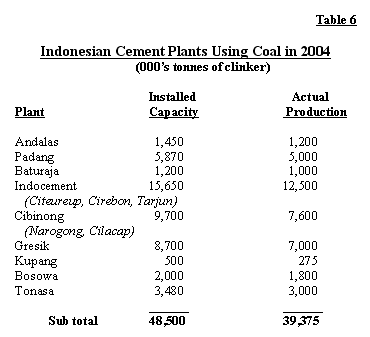
Much of the cement industry converted to using coal during the 1980?s and 1990?s, and the new plants built during that time were based on coal. The cement plants in Indonesia using coal in 2004 are shown in Table 6. This table includes the Andalas plant in Aceh which was severely damaged by the tsunami of December 26, 2004. The plant may not be rebuilt or, if so, moved to a different location.
The coal consumption of cement plants in 2004, and forecast for 2005 to 2008, is shown in Table 7. All of the six million tonnes of coal required in 2004 was sourced from Indonesian mines. Some coal used to be imported for cement plants in the 1990?s for plants that were built on imported coal quality specifications. However all these cement plants have now adjusted to using domestic coal and some plants even use a high moisture, low heat value coal. In general the cement plants find domestic coal is competitive in price and performance against all other fuels including gas and imported coal.
The cement industry forecast coal consumption of nearly seven million tonnes in 2008 is based on increased utilization of the capacity of the existing plants. Steady economic growth of the country will lead to increased cement demand and the export demand for cement will probably stay strong. Some new cement plants are being planned but these will only start up at the earliest in 2008.
Industrial
The domestic industrial market demand for coal is essentially for three groups of users:
- pulp and paper plants
- metallurgical plants
- small industries such as textiles, sugar processing, brick making and manufacturing


The estimated industrial domestic coal use in 2004 was 5.6 million tonnes and is forecast to grow to 6.8 million tonnes in 2008 (Table 8). This forecast of coal demand contains a large degree of estimation for local industry use as accurate figures do not seem to be available for this sector of the domestic market.
In 2004 the percentage of the industrial market for coal was:
- pulp and paper 43%
- metallurgical 2%
- local industries 55%
Some growth in coal demand is expected from the pulp and paper sector this year but after that to be essentially flat except for one new coal fired pulp and paper plant starting up in 2006.
The metallurgical sector is relatively small and will be even smaller from 2005 as the Newmont Minahasa mine has closed with the exhaustion of its minable reserves. Growth will come with the start up of new mines, such as lateritic nickel mines, but that is still some time in the future.
The big market is, paradoxically, from small industries. Growth in this market has been strong since 2001 and is in large part a response to high oil and diesel prices and the recognition that domestic prices of such fuels will go higher as fuel subsidies are removed. Local industries are converting boilers to coal use or using coal as a fuel wherever possible.
Almost all of the coal fired local industries are on the island of Java and the coal is brought by barges into ports. The four ports that handle the coal to small industries are:


One domestic coal market that was heavily promoted in the middle 1990?s was that of coal briquettes as a small industry and household fuel, mainly to replace the use of kerosene and firewood. A number of briquettes plants were planned, trial plants were built and test marketing done. However the cost of briquettes to the end user was relatively high and this market has not developed. Small industries find that coal is cheaper and households prefer gas and electricity where it is available or kerosene as it is still a subsided fuel and readily available throughout the country.
Domestic Coal Supply and Logistics
Domestic Coal Supply
Coal supply to domestic customers is from mines in Kalimantan and Sumatra. The six largest coal suppliers to the domestic market in 2004 were: (million tonnes)
These six companies provided 74% of the domestic demand in 2004. A wide range of companies provided the other 26%, or 9.4 million tonnes, almost all from mines in southern Kalimantan.
Future supply will come from the same group of companies though if Kaltim Prima becomes, as is possible, a major supplier to the Tanjung Jati B power plant it will become one of the larger domestic suppliers. The Cilacap power plant is expected to be supplied by Adaro, Jorong and Kideco while the Tanjung Kasam may get some of its supply from mines in Sumatra close to the power plant.
Almost all of the coal used domestically is sub-bituminous quality, defined for this purpose as coal with total moisture of more than 15%. Even the cement industry, which on a worldwide basis traditionally uses coals of higher heat value, domestically uses mainly the higher moisture, lower heat value coals. This is a reflection of the delivered economics of sub-bituminous coal in Indonesia and its long term availability compared to Indonesian bituminous coal, which obtains a high price in the Asian export market and has a shorter term future availability.
Of significance has been the growth in domestic markets of the use of high moisture, plus 30% total moisture, lower heat value coals. Indonesia has an abundance of such coal and use of this type will provide buyers with long term fuel security at competitive prices.
Already power stations such as Cilacap and Tanjung Kasam are being built with this type as the design coal, and both Tanjung Jati A and the new Paiton plant developers are considering such coal as the primary fuel.
Logistics
A wide range of transportation methods is used to deliver the coal from the Indonesian mines to the domestic customers.
Coal supply to the Suralaya power plant is based on a ?coal chain? concept. This chain involves the use of the 450 km railway from the Bukit Asam mine, the modern coal terminal at Tarahan and the use of specialized belted self unloading vessels transporting the coal from the Tarahan port in southern Sumatra across the Sunda strait and delivery into hoppers at the coastal power plant at Suralaya, Banten. This is an efficient delivery system for coal from an inland mine. However when elements of the chain are disrupted or are at reduced capacity, notably the railway, delivery of coal from other mines is much less efficient as the Suralaya receival terminal was not designed for other types of delivery. Coal is also delivered to Suralaya by vessels, both Panamax and Handy size, and by barge, but at considerably reduced rates because of the limitations from the port being designed for a single type of specialized delivery.
The Paiton power complex was also located on the coast of Java to receive seabourne coal. The PLN units at Paiton were designed for ship delivery with shore based unloading equipment but quickly it was recognized that barge delivery provided lower cost supply. The ship unloading equipment is now used to unload barges with conveyors taking the coal to stockpile.
The private power plant units at Paiton were built for self discharge vessels to unload into shore based hoppers with conveyors to stockpiles. Specific self discharge, high performance, Handymax vessels were also built as part of the financing requirements to ensure reliable deliveries. It is now recognized that this did not add to the economics of electricity generation as the reliability of delivery could be guaranteed by the large number Handymax vessels available in the worldwide fleet.
One of the Paiton complex operators, PT Paiton Energy, has more recently installed shore based unloading equipment and is now receiving most of its coal supply by large barges, in the 8,000 to 14,000 tonne range, from coal suppliers in southern Kalimantan.
The Tanjung Jati complex is also located on the north Java coast to receive coal through water bourne delivery. The first units, Tanjung Jati B, are designed to receive coal by vessels of Panamax size and currently are not accepting bids for barge deliveries. However the next units of Tanjung Jati will probably be designed for barge delivery, as the large barges now used in the domestic coal trade provide the lowest delivery cost of coal to Java.
The Cilacap power plant is again at a coastal location in Java and is designed for only barge delivery. The power plant serving the Batu Hijau mine receives coal by barge but the Freeport mine power plant receives coal by self discharge vessels given its location further from coal mines and where the economics of barge transport are not as good as those of ship delivery.
The cement plants of Indonesia are in many cases located away from the coast and closer to the supply of the major raw material for cement, limestone. The coal deliveries for cement plants are now almost all by barge, and delivery is into coastal stockpiles. Coal delivery to the cement plant is then either by truck, notably to cement plants in West Java, or by conveyor where the cement plant is relatively close to the coast, or in the case of Indocement?s Citeureup plant, by rail. It is expected that any future cement plant will look more to a coastal location both to receive its fuel, coal, and to deliver its final product, with limestone being transported longer distances.
Truck transportation of coal is highly developed for supply to the industrial market in Java. Coal for all customers in this market is delivered by barge to stockpiles and then trucked to the customer. Over 6 million tonnes of coal will be delivered this way in 2005. Barges of coal for industrial customers are unloaded by excavators or front end loaders to trucks or direct to stockpile, with shore based unloading equipment being seen as an unnecessary capital cost. The barge and truck logistics for domestic coal delivery is now well developed and efficient, particularly in Java.
The Future
The domestic demand for coal will continue to grow as coal, and the delivery of coal from domestic mines, gives the lowest cost fuel option to many users, most notably in the power sector.
The future growth of domestic coal demand, though, is going to be largely dependent on the development of new coal fired power stations. The demand growth for coal in the cement industry will be steady but for the next three years will be related to only output increases in existing plant. Much of the industrial market for coal has already converted to coal fired plant and coal demand growth will be relatively low though new industrial plants may be regulated to use coal to conserve oil and gas supplies.
The industrial energy market in Indonesia is currently distorted by fuel subsidies favoring petroleum products. If, or when, these subsidies are removed, coal, with its very large domestic supply base, will further strengthen its position as the low cost fuel of choice in the industrial domestic market.
However the big growth in domestic coal demand will certainly be for use in new coal fired power plants. Two such plants are under construction to start taking coal later this year and a number more are planned.
The domestic use of coal is expected to grow at an average rate of about 3 million tonnes a year, though at a reduced level in 2008 and 2009. From 2010 on demand will increase again as Indonesia?s demand for energy translates into new coal fired power plants.
The growth of the Indonesian coal industry will ensure there is a ready supply of coal for the domestic market. By 2010 Indonesian coal production could be over 200 million tonnes a year and this will ensure a competitive supply of coal. Some of the Indonesian coal industry will in turn look to the domestic market for its growth, particularly the low heat value, high moisture coals of which there are large resources in southern Kalimantan and southern Sumatra.
This type of coal may not be profitable for the export market but with its coastal location is very suitable for barge delivery to the next generation of power plants. There are no restraints in the logistics system of delivering coal to the domestic user.
Looking at a longer time scale two major domestic markets for coal could develop:
- large on-site power stations sited on low heat value coal resources with power transmitted by cable. This is a likely scenario for the Sumatra coal resources
- liquifaction and/or gasification. This is even further in the future but as the demand for energy relentlessly moves on, so will the technology that will allow the full development of Indonesia?s large coal resource base.
For much of the last century domestic coal demand provided the stimulus for the growth of Indonesian coal production. The future will be that the continuing growth of the Indonesian coal industry will provide a low cost fuel to meet Indonesian rising energy demands. (END)