

OPINION: South Sumatra Coal Transportation System, By Cicip Hadisucipto
Friday, July 29 2005 - 07:01 AM WIB
1. PROJECT BACKGROUND
PT Transcoal Nusantara and PT Trimitra Adiyasa have formed a consortium in order to develop a coal transportation and terminal system in South Sumatra. Studies of the coal transportation and terminal system have been done by the consortium. In October 2004, the consortium has received a recommendation as the exclusive developer for the South Sumatra Coal Transportation and Terminal System from the Governor of South Sumatra. Further through the signing of the Heads of Agreement on Coal Supply with PTBA, the consortium has moved ahead towards securing a long-term coal supply contract.
2. THE PROJECT
2.1. Background ? Geographical
The followings are the significant factors for the implementation of the Project:
South Sumatra coal reserve is situated in the most developed region, which is west region of Indonesia (KBI). For major customers in ASEAN and European countries it is more efficient in freight cost compared to coal from Kalimantan or Australia.
Proven resource of coal in the South Sumatra is quite sizeable. PTBA manages the largest proven coal reserve in the region which amounting approximately to 1.8 billion tons.
Due to the crisis in the late 1990?s, the Indonesian economy currently needs much income from exports. The Project will bring in foreign currency income to Indonesia.
Existing infrastructure in the region is insufficient for efficient coal transportation. Therefore there is a need for efficient and reliable coal transportation system and JV will be able to provide this.
One of the main factors contributing to the strengths of the Project is the geographical condition of South Sumatra which, other that it is strategically located, provides abundant of natural resources (such as coal, oil, gas and good water transportation system).
The Project, however, does have its constraints too. The area has inadequate regional infrastructures. It has swampy land. Its poor earth conditions make it costly for road/railway construction or maintenance. To make it worse, land reinforcing material cannot be sourced locally. Intensive sedimentation of the rivers will also create problems in coal transportation. The following map illustrates the soil conditions of the Project area.
2.2. Description of the Project
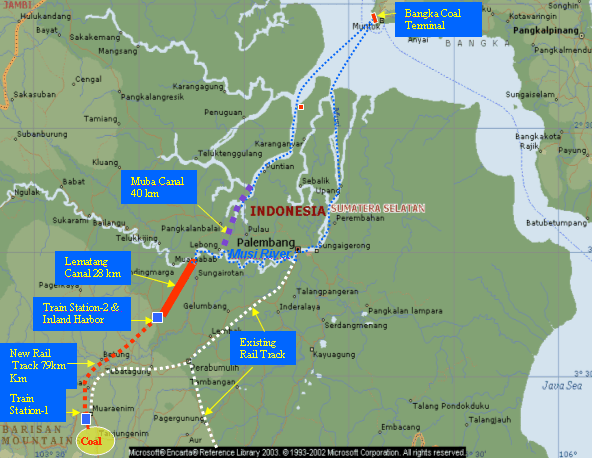
The Project is a coal transportation and terminal system consisted of three segments: Railway System, Inland Waterway System and Deep Sea Coal Terminal System. This transportation system will be used to carry coal from PTBA?s location in Tanjung Enim, South Sumatra to a deep sea coal terminal located at Muntok, Bangka Island. There are two alternatives of waterways: one through Musi-Banyuasin river and the other through Musi river. Although distance of coal transportation via Musi-Banyuasin river is shorter than that of Musi river, its investment cost is higher as it needs two canals (Lematang Canal and Muba Canal) to be built, whereas only Lematang Canal is needed should the coal be transported through Musi river. Areas travelled from PTBA?s mining site to Muntok?s coal terminal are indicated in the following map of location.

2.3. Coal Handling Process
Process of coal handling starts from PTBA?s mining area which is located at Tanjung Enim and ends at a coal terminal at Bangka Island. The coal handling process goes through two different systems, one through railways and the other by waterways through canal and river.

Under the Coal Supply Agreement between PTBA and the Joint Venture Company (JV), both parties agreed to an annual 20-million ton of coal purchase. The coal will be brought out to a train station off site of Tanjung Enim. The coal will be loaded into wagons and be transported for approximately 84 kilometers using trains with steam locomotive from Train Station-1 to Train Station-2 where the coal will be unloaded using wagon tippler. The coal will be moved through a conveyor for about 200 meters to a temporary coal silo where it will be stored before loaded to barges at the inland harbor.
From the inland harbor, the coal will be loaded to barges. The coal will then be transported through a 28-km Lematang Canal then through Musi-Banyuasin river (183 km) or Musi river (238 km). Once the barges reach Bangka Straits, they will be directed to a deep sea coal terminal and be unloaded to coal stockyards after which the coal will be loaded to end buyer?s ships.
2.4. Project Cost
Project cost is estimated to be USD 500 million for investment of coal transportation via Musi river. Land acquisition and construction of coal transportation system will take about 2 ? 3 years to complete.
2.5. Land Acquisition
The investment for the coal transportation through railway system and waterway system requires land to be acquired by JV. Areas of land to be acquired are for railway tracks for approximately 84 kilometers, two railway stations, Lematang Canal (28 kilometers), coal silos, inland harbor and others. Most of these lands are owned by Municipal Government of South Sumatra. The Project is already fully supported by the governor himself through the exclusive recommendation letter issued in October 2004. In addition, land acquisition process will also be supported by the proposed land acquisition law which is in the final stage of approval by the central government. This land acquisition law is said to regulate the sellers in which if the majority of land owners in the area of acquisition have signed a deal with the buyer for an agreed price, the minority owners must follow the terms which have been agreed by the majority owners with the buyer.
2.6. Railway System
Railway tracks run from mining site of PTBA at Tanjung Enim to inland harbor next to Lematang or South Canal. This railway system uses Coal Fueled Steam Locomotive (QJ type). This locomotive is made in China and has 3,000 horsepower. The system will also have 47 units of 60-ton rail car/wagons.

Railway system generally consists of 6 (six) sub-system as briefly described below:
? Main stations and yards, at the coal mine and at the inland harbor. These stations are equipped by emplacement, shunting track, rail loops, train loading hopper, rotary car dumpers. These facilities are mainly dedicated to load and unload the coal which is planned to have nominal loading and unloading rate 4,000 ton/hour.
? Main hauling track 79 km, including bridges of approx. 600 m in total and 4 passing loops of 1.50 km each. The main track is longitudinally graded by -0.61m/km (decline). 600 m bridges are planned to be steel structured. Along the main hauling track, there are also 4 passing loops which one of it is an emergency station.
? Rolling stock. The railway operation will adopt a merry-go-round system, whereby locomotives remain attached to their wagons throughout the entire operating cycle of train loading and unloading. This way, when a train arrives at the loading/unloading point, it may begin loading/unloading without delay and proceed on its journey immediately after the loading/unloading operation is finished. To transport 20 Mt coal per year, 376 wagons and 13 coal-fired steam locomotives are needed.
2.7. Waterway System
? The waterway system started from inland harbor in where the coal from railway system is unloaded by using rotary car dumper and directly re-loaded by using conveyor-shiploader onto pusher-barge. The barge will then transport the coal through the 28 km Lematang Canal, 185 km Musi River and 25 km seaway of Bangka Strait.
? The pusher-barge is special designed and optimized with reference to the worst conditions of Musi River, resulted into about 5,000 DWT barge with 1,600 to 1,800 HP which can attain a sailing speed of 7.50 knot, either empty or fully loaded. Dimensions of pusher & barge can bee sen in the appendix (Waterway System).
? By assuming sailing speed 7.50 knot in average, loading and loading time 4,000 ton/hour each and departure interval = 2 hours from each port, required number of barge = 22 units (20 in traveling + 2 in loading/unloading) and pusher 19 units (18 in operation + 1 backup).

2.8. Coal Terminal
? The coal terminal is planned to be built at Tanjung (Cape) Kelian, Bangka Island, about 25 km distanced from Musi River Mouth.
? This location is selected based on geotechnical conditions where the land is geologically underlied by massive sandstone at the upper part and massive granite at the bottom.
? Climatologically, this location is at a hidden position behid extreme wind effects probability come from South China Sea, so activities must be relatively safe.
? Continuous 22 m water depth is distanced only 350 m from the shore, meaning the approach jetty construction cost should be lower than other locations in Southern Sumatra.
? By occupying 22 m water depth, the terminal will be accessible by max. 300,000 DWT vessel size of which long distance ocean freight cost is generally lower than smaller vessel.
? Design capacity of coal handling equipment are entirely 4,000 ton/hour, or about 5,000 hour occupancy rate about 57% in a total system.

3. PT TAMBANG BATUBARA BUKIT ASAM (PERSERO) TBK
3.1. Brief Background
PTBA ? a public listed stated owned coal mining company of the Republic of Indonesia occupies 5,900 million tons (Mt) of coal resources of which is about 1,840 Mt categorized as the marketable coal base on its quality, current price and markets acceptability. The rest 4,060 Mt is lignite (brown coal) which is may be economic for sale to mine mouth steam power plant. Amongst the resources, there are coal reserves recently available to be mined by open cut mining methods: 411.81 Mt at SR (Stripping Ratio) 3.54/1 and 792.86 Mt at SR 4.80/1.
Currently coal reserve is produced/sold on the averaged level of approx. 10 Mt per year, 7.05 Mt per year is transported 420 km via existing railway to Tarahan Coal Terminal in Lampung Province, 1.32 Mt per year is railed 160 km to Kertapati Coal Port on Musi River ? Palembang, and the rest 1.40 Mt per year is most likely sold to the mine mouth Bukit Asam Power Plant owned by PT PLN ? Indonesian State-Owned Power company.
Available coal reserve of PTBA is at least 343 to 600 Mt. Amount which can be produced and sold every year is about 18.80 to 28.43 Mt of coal. In the coal marketing point of views, PTBA coal is worldwide acceptable mostly in power plant market segments.
3.2. Assignment on the Coal Supply Agreement
JV will sign a Coal Supply Agreement with PTBA. In this agreement, PTBA will commit to supply JV with 20 million tons of coal per annum for 15 years. In the event of default by JV, the financing party can take over the assignment of this coal supply agreement and execute it accordingly.
This assignment of the Coal Supply Agreement is supported by an arrangement in which if PTBA, in one way or another, is not able to supply JV with the required 20 million of coal, JV reserves the right to step in and mine at PTBA?s concession field up to the agreed amount and needs to pay only a certain sum of money as royalty to the Government. (*)