

W. Natuna?s Kakap PSC profile update
Thursday, January 22 2004 - 04:49 AM WIB
Permit: Kakap
Status: Production, Exploration
Novus?s Interest: 25.0%
Other Interest Holders: Star Energy (31.25% & operator); Premier Oil (18.75%); Singapore Petroleum (15.0%); Pertamina (10.0%)
Novus?s interests in Indonesia are held through a production sharing contract (PSC). The PSC is an agreement that sets out the basis for contractors operating petroleum licence areas in Indonesia. Under the terms of PSCs in Indonesia, contractors are entitled to take 80% of all hydrocarbon production until all accumulated historical costs are recovered, with the 20% balance set aside for profit sharing (Profit Oil). After recovery of historical costs all production is treated as Profit Oil. The Indonesian government generally takes 85% of all oil production and 30% of all gas production inclusive of tax. In addition, contractors are obliged to supply 25% of their share of oil production after cost recovery into the domestic market at a fixed price pursuant to a domestic market obligation.
PROFILE OF KAKAP

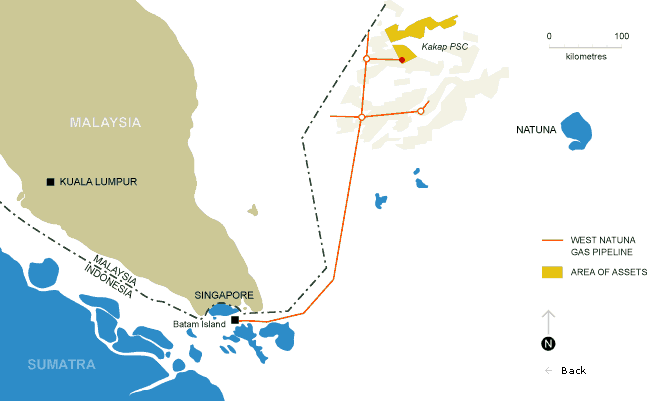
Novus has a 25% interest in the Kakap PSC which is located in the West Natuna Sea Basin, approximately 1,000 km north of Java. The Kakap PSC consists of two separate areas: South Kakap, which contains all the producing fields, and the much larger North Kakap, which is comparatively unexplored. The first production was from the KH field in 1986.
Gas is delivered to Singapore under a long-term contract via the 654 kilometre long West Natuna Transportation System (?WNTS?) into Singapore. The West Natuna Transportation System commenced exporting gas to Singapore from the Kakap PSC in early 2001. Three PSC joint ventures have the following interests in the WNTS:
? Block B (43.1%), operated by ConocoPhillips (also WNTS operator);
? Block A (36.9%), operated by Premier; and
? Kakap (20%), operated by Star Energy.
Gas is sold in US$ to SembGas, a Singaporean gas distributor, under a 27 year gas sales agreement. The agreement provides for the sale into Singapore of approximately 2.5 tcf of gas over the contract period, with delivery having commenced in March 2001. The gas price is indexed at a premium to the Singapore quoted spot price for High Sulfur Fuel Residual Fuel Oil 380 Centistoke (?HSFO?) which is traded on the Singapore International Monetary Exchange. The historical HSFO price is illustrated below:

Since 1994, HSFO has traded at a 24% discount to WTI (West Texas Intermediate). However, during calendar 2003, HSFO traded at a discount of only 18%.
The following table sets out Novus?s interest in the Kakap PSC reserves as at 31 December 2003:

The total production for the Kakap PSC for the three years ended 31 December 2003 is set out in the following table:

VALUATION OF KAKAP
A value in the range US$70-80 million has been attributed to Novus?s 25% interest in the Kakap field.
Gas production from the Kakap field is supplied to Singapore under a long term gas sales agreement. Field upside is provided by the opportunity to supply gas at greater than contracted volumes (Singapore has recently been taking gas at 115% of the contract rate) and some potential to delineate additional gas reserves.
Two scenarios were developed to assess the value of Novus?s interest in the Kakap field. They reflect likely production profiles over an expected remaining field life of 17-19 years. The scenarios used in the analysis were as follows:
? Scenario 1:
Scenario 1 is based on the operator?s current life of field forecasts. A total of 314 bcf of natural gas, and 23 MMbbl of oil and condensate (100%) is produced over the life of the field. Production for the five years to 31 December 2008 averages around 98 MMcfd. Total capital costs for the life of the field are US$92 million.
? Scenario 2:
Scenario 2 assumes the delineation of some additional gas reserves and an increase in the rate of production to around 112% of the contracted rate. Under Scenario 2, a total of 398 bcf of natural gas and 34 MMbbl of oil and condensate (100%) is produced over the life of the field. Production for the five years to 31 December 2008 averages around 109 MMscfd. Total capital costs for the life of the field are US$92 million.
The price realised for gas sales from Kakap is based on the high sulphur fuel oil price and, indirectly, the crude oil price. For commercial reasons, Novus has requested that Grant Samuel not disclose the detailed terms of the contractual arrangements for the Kakap field.
The results of the NPV analysis for the Kakap field, based on a range of different oil prices and discount rates, are set out below:


Gaffney Cline undertook an EMV analysis of the exploration opportunities at Kakap and has valued these in the range of $0-2 million, which is not reflected in the DCF valuations above.
Grant Samuel has assessed the value of Novus?s production and exploration interests in the Kakap field in the range US$70-80 million, which reflects the DCF analysis and a subjective assessment of sovereign risk.
INDEPENDENT TECHNICAL SPECIALIST?S REPORT ON THE PETROLEUM ASSETS OF NOVUS PETROLEUM LIMITED
This report has been prepared independently by Gaffney, Cline & Associates (GCA) with due regard to the Valmin Code issued by the Australasian Institute of Mining and Metallurgy. It will be appreciated that GCA has neither sought nor received any relevant third-party authorizations that may be necessary for the information provided herein to be entered into the public domain.
ASSET DESCRIPTIONS
The Kakap PSC is located in the relatively remote but highly petroliferous West Natuna Sea, approximately 1,000 km north of Java and 250 km east of the Malay Peninsular. Several large oil and gas fields have been discovered in the Natuna Sea since the late 1960?s and a major West Natuna Gas (WNG) scheme has recently been completed to deliver gas from three PSCs, including Kakap, to Singapore.
The Kakap PSC comprises two separate areas: South Kakap, which contains all of the producing fields and discoveries, and North Kakap, which is relatively unexplored, but contains some exploration prospects and leads. The combined area of the PSC is approximately 2,000 sq km and it expires in 2028.
Oil is currently being produced from 10 fields with average gross production of 8,957 bopd during third quarter 2003. Gas production commenced in March 2001 and has steadily increased to a peak of 75 MMscfd during 2003.
The accumulations in the West Natuna Sea area are mainly in Miocene and Oligocene fluvio-deltaic sandstone reservoirs in inversion and wrench anticline structures. The reservoirs are of excellent quality with average porosity typically in the low twenties and permeability up to 500 mD. The reservoir units are typically 10-50 m thick and isolated by sealing shales with separate hydrocarbon contacts within the same field. Secondary reservoirs are present in deeper Eocene continental sandstones with porosity in the range 10-25% and permeability up to several hundred mD.
The South Kakap area has been the major focus of exploration and development activity. The entire producing and prospective portion of the block has been covered with 3D seismic data, providing control for development, appraisal and exploration drilling and a total of 79 wells have been drilled (24 exploration, 14 appraisal and 41 development). Drilling results to date in North Kakap have not been encouraging for the presence of significant hydrocarbon volumes. As a consequence exploration in this area has been less intensive though several prospects and leads have been identified.
PRODUCING ASSETS
Until recently Kakap has been developed only for oil production. In March of 2001 the terms of the PSC were renewed, coincident with the first deliveries of gas to Singapore under the sales agreement for West Natuna Gas. Ongoing development of the area over the next few years will be shifting focus to bring future gas potential on production.
Oil and gas production is based on ten producing fields comprised of four main production platforms: KF, KH, KG and KRA (Figure 5). Six other satellites make up the subsea production tied back through the four main platforms: Jangkar, Nelayan, KG-5A, KRN, KR and KRA South. Of a total of 46 wells comprising 54 strings, 34 are oil producers, 7 gas producers, 2 used for gas injection and 11 are shut-in. Currently production is from KF, KH, KG, KRA (Figure 4), Nelayan, KRN and KR-1.
NON-PRODUCING ASSETS
It is expected that well KRA-2X will have a workover and be tied into the production facilities in 2006. This is expected to offset the current decline in oil production for a few years.
KAKAP FORECASTS
GCA's Scenario 1 assumes that production will be from those fields that are developed at the present time together with the KRA-2X well workover. The long history of production means that reserves can be estimated with a fair degree of confidence and GCA has generated reserves estimates that are similar to Novus?s. For Scenario 2 GCA has assumed however, potential production rate upside with the production of some possible reserves.
In addition to the workover of Well KRA-2X, projected capital investments include a pipeline to bring KG gas production on line and a low-pressure gas compression platform.
The production and cost forecasts and the corresponding reserves are presented for Scenario 1 and Scenario 2 in Tables 2 and 3, respectively.
WNTS Pipeline Interest
Effective weighted revenue interest holding:
Novus interest (through Kakap PSC): 5%
Other Kakap PSC parties: 15%
Natuna Sea Block A: 36.9%
Natuna Sea Block B: 43.1%
The Kakap PSC also participates in the ownership of the shared pipeline infrastructure from West Natuna to Singapore. Accordingly Novus has the potential to receive a stream of tolling revenue from any party using this pipeline. GCA has reviewed potential contracts to transport gas and has taken into account, in the total Kakap asset revenue stream, likely tolls received from a 50 MMscfd contract for 18 years commencing 2007 at a toll of US$ 0.45/MMscf escalated at CPI. This additional revenue from tolls is included in both Scenario 1 and Scenario 2 economic scenarios for Kakap.
EXPLORATION POTENTIAL
The joint venture committed to drill four wells as part of a PSC extension agreement, of which two have now been drilled. One well is required to be drilled before March 2005 in the North Kakap area. The final commitment well is to be drilled before March 2011.
The joint venture is maturing an oil play in the North block. The KT prospect is a mild inversion structure located in a relatively favourable area with respect to the risks for hydrocarbon charge and seal preservation. However, the risks associated with this area are reflected in the fact that the joint venture is trying to negotiate to acquire 3D seismic data in lieu of the well commitment or to have the option to transfer the commitment to South Kakap.
The other commitment well could be Pancing-1 in South Kakap which would be a test of the syn-rift play. This prospect is a high side fault closure with objectives in the basal sand unit and fractured pre-Tertiary basement. However, this is considered to be a gas prospect and there is no urgency to discover additional gas in the area. The joint venture would prefer to target oil plays, but the potential of the remaining prospects is considered to be relatively low.
The exploration potential in the Kakap PSC is limited. Some upside exists for gas, but there is no incentive to explore for additional gas volumes in the short to medium term. The South block has been thoroughly explored and it is considered that the remaining volumes of oil are relatively small and in many cases the expected recoverable volumes would be sub-commercial, even with the existing infrastructure. Accordingly, very little value can be assigned to the exploration potential of the Kakap PSC.
GCA has estimated that the value of Novus?s exploration interests in the Kakap PSC described above lies in the range US$ 0MM to US$ 2MM. (end of profile)