

OPINION: "Indonesian Participants" in the context of Coal Contracts of Work
Monday, December 20 2004 - 06:30 AM WIB
The recent press reports have indicated that PT Kaltim Prima Coal ("KPC") is still in negotiations with the Government in relation to reaching agreement on the price at which the 32.4% of the shares in KPC currently held by PT Bumi Resources (through foreign incorporated subsidiaries) must be offered to "Indonesian Participants" as required by KPC's Coal Contract of Work ("CCOW").
The KPC example is an interesting one from the perspective of how different intermediate shareholding structures used by both Indonesian and foreign mining companies can give rise to different results in determining whether the divestment requirements of a CCOW have been met.
Nature of Divestment Requirement
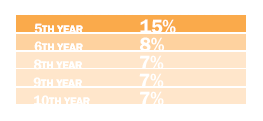
The first generation CCOW requires that, commencing from the fourth year of production of a mine, the mining company that is the party to the CCOW must either offer to issue new share capital, or procure that its then-current foreign shareholders offer to sell, a certain percentage of shares to "Indonesian Participants", such that by the end of the tenth year, the CCOW mining company is at least 51% owned by Indonesian Participants. The common structure is as follows:
Indonesian Participant
On first glance, it would appear that when PT Bumi Resources Tbk ("Bumi") purchased a 100% interest in KPC from Rio Tinto and BP, the divestment requirements of the CCOW would be satisfied, as Bumi Resources is clearly an Indonesian company. However Bumi finds itself in a position where it is being compelled to implement further the divestment requirements of the CCOW.
The question as to whether the divestment requirements have been fully satisfied is impacted upon by two key factors:
(a) what shareholding structure has been adopted for the CCOW mining company; and
(b) even if an Indonesian company holds the shares in the CCOW mining company, whether the elements of an "Indonesian Participant" have been met.
Intermediate Foreign Shareholding Structures
In relation to the first issue, Bumi holds its 100% interest through two foreign subsidiaries as shown below: 
Accordingly, the (direct) shareholders in KPC are in fact two foreign companies, not an Indonesian company. The divestment provisions of the CCOW provide that the requirements are only fulfilled when "? not less than 51% of the total shares issued and outstanding (in KPC) shall have been offered and purchased by the Indonesian Participant". The definition of "Indonesian Participant" requires the direct shareholder to be "? Indonesian Companies controlled by Indonesians".
Accordingly, as the two offshore companies are not Indonesian Participants (despite the fact that they are wholly owned by a company that would qualify as an Indonesian Participant), the divestment requirements have not been satisfied.
Clearly, the initial structure put in place by BP and Rio Tinto was advantageous to both themselves and Bumi, as it allowed them to ultimately sell their 100% interest in KPC at an offshore level (i.e. by selling the shares in the SPVs instead of selling the shares in KPC), thereby avoiding the need to obtain various Indonesian Government approvals (such as approval from the Ministry of Energy and Mineral Resources or BKPM). However, the structure works against Bumi in terms of the divestment requirements.
Listed Indonesian Companies as Indonesian Participants
In relation to the second issue, where an Indonesian listed company is the direct shareholder in a CCOW mining company, there may still be issues raised as to whether that company satisfies the requirements of Indonesian Participant.
As mentioned above, an Indonesian Participant is required to be (i) a company incorporated in Indonesia, and (ii) a company controlled by Indonesians. The capital markets requirements in Indonesia do not allow a listed company to put any restrictions on the trading of its shares to ensure that it does not inadvertently become majority controlled by foreigners. Particularly in the recent years of debt restructuring and work-outs, there have been examples where (due to debt for equity swaps with foreign creditors), Indonesian listed companies have gone from Indonesian controlled to foreign controlled overnight.
It is therefore not clear what the position will be in terms of the divestment requirements. Clearly, the Ministry of Energy and Mineral Resources is not equipped to constantly monitor the shareholding of public companies to determine whether they remain Indonesian controlled. It would also be a strange result if, say, after the divestment requirements being dormant for a number of years, the Indonesian company was suddenly required to re-commence the divestment process simply because it became foreign controlled through public trading on the stock market.
Similar considerations apply when looking at interests in CCOW companies held through a chain of Indonesian companies. The examples below highlight the point:
The CCOW requires that 51% of the shares in the CCOW mining company be held by "an Indonesian company controlled by Indonesians".
In Example 1, the CCOW mining company is ultimately 51% beneficially owned by foreigners. Therefore it would appear that PT Holding Co 1 is not an Indonesian company which is controlled by Indonesians.
However in Example 2, PT Holding Co 1 is an Indonesian company controlled by Indonesians (as its major shareholder is PT Holding Co 2, which in turn is 100% owned by Indonesians. However the net effect of this structure is that the foreign party directly and indirectly owns 73.99% of the CCOW mining company.
These issues have to our knowledge not been tested with the Ministry of Energy and Mineral Resources or the Indonesian courts as yet. It will be interesting to see what approach is taken. (*)