

Straits Resources reports stable production, lower sales in H1
Saturday, August 23 2003 - 12:49 AM WIB
Results
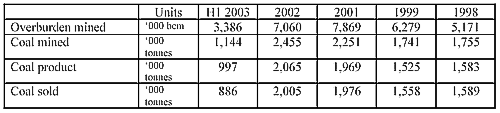
At the Indonesian coal operation, the mine achieved steady production levels for the half-year period. However, coal spot prices continued to remain low and coal sales were held back in response to these market conditions. Sales are expected to improve in the second half of 2003.
Review of Operations
The Sebuku coal mine in Kalimantan in Indonesia (owned 80% by the company) has achieved steady production levels in the first half of 2003.

Mining activity focused on the newly developed Kanibungan pit and the northern Tanah Putih mining area. Strip ratios, at 2.9, were higher than budget but were consistent with the life of mine average. A number of mine development activities were completed in the first half and it is expected that lower strip ratios will feature in the remainder of the year.
The Coal Preparation Plant (CPP) continued to perform well with a new monthly production record of 229,000t of coal product being set in June.
High coal inventories resulting from regional oversupply and weak demand meant that lower production targets were set during April and May. During this period the opportunity was taken to increase the level of preventative maintenance work on the CPP to allow for higher utilisation rates later in the year. Coal sales were held back in response to market conditions and to accommodate the revised production schedules.
All coal sales met customer quality requirements.
Financial
The Sebuku coal mine EBITDA and EBIT were a loss of $0.68m and $2.4m respectively for the six months to 30 June 2003. Coal prices received were roughly in line with budget but revenues were reduced due to lower sales volumes.
Unit operating costs per tonne sold were impacted by lower sales volumes as well as higher than budgeted strip ratios. This situation should be reversed to an extent over the second half of the year as higher levels of committed sales and lower stripping ratios take effect.
The cost reduction program implemented at Sebuku in 2002 remains on foot and further significant cost reduction activities are targeted for the second half of 2003.
For accounting purposes, VAT of US$1.7 million paid in the first six months of 2003 has been expensed for which no refund has been received to date. There is continuing uncertainty within the Indonesian legal and government system over this issue. The company continues to work to resolve this matter and maintains the belief that it will not ultimately be required to bear the burden of the additional impost.
Exploration
Exploration has continued to add to the resources and reserves at Sebuku. In April it was reported that since 31 December 2002 a further 3.6 million tonnes has been added to reserves and 1.9 million tonnes to the resources Coal reserves stand at 10 million tonnes with a mine life through to 2008. Successful exploration drilling has continued in the northern areas of Tanah Putih during the first half of 2003 and the expectation is that the mine life at Sebuku will be further extended.
Marketing
The second quarter of 2003 proved to be a difficult period for thermal coal producers. Global instability and uncertainty across a broad range of geo-political economic factors continued to hold back industrial production around the world and consumers approached procurement and inventory controls on an extremely cautious basis. The outbreak of SARS served to amplify this situation as normal business channels became restricted.
In order to counter reducing margins a large number of thermal coal producers resorted to increased production in an attempt to maintain profitability. This was particularly the case in Indonesia and Australia where production levels increased by approximately 15% and 10% respectively on a year on year basis. This large volume of new capacity swamped the fragile demand base with the result that spot prices collapsed back to the Asian Crisis levels of 1998. FOB spot prices out of NSW fell to just under US$22/mt.
Sebuku adjusted its business plan during this period to compensate for the prevailing conditions by limiting exposure to the spot market. This was achieved by actively holding back on combined production and sales. Coinciding with this strategy, Sebuku also embarked on an aggressive review of key cost drivers to restore competitive margins in spite of depressed market conditions.
It appears that June represented a watershed in the supply/demand balance for thermal coal trade for the year. The rapid fall in the value of the US dollar against the majority of currencies appears to have served to stem the tide of new capacity. Consolidation and significant cutbacks have been announced, whilst at the same time, demand has picked up due to improving fundamentals in the global economy. Looking ahead prices look set to follow a steady upward trend over the rest of the year with buyers returning to a longer term outlook within their procurement policies.
Against this background Sebuku is set to restore production levels in the second half of 2003 and improve both margins and sales volume. (end of report)
Editor?s note: Australian-based Straits Resources Limited has an 80 percent shareholding in PT Bahari Cakrawala Sebuku, which operates an opencut truck and shovel coal mining in Sebuku Island, South Kalimantan province. The remaining 20 percent shareholding is held by PT Reyka Wahana Digdjaya.