

FOCUS: Mining bill seeks to strike a new balance
Monday, November 11 2002 - 12:26 AM WIB
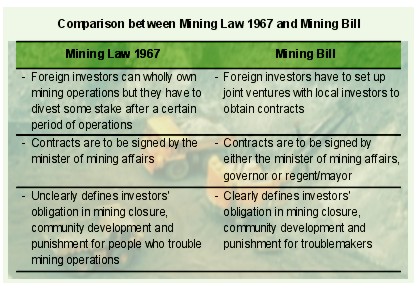
The government looks set to strike a new balance between the interest of mining investors and the national interest as shown by the general mining bill that has been drafted by a government team.
The bill, whose copy was made available to Petromindo.Com and which will be presented to the Cabinet for approval in the near future before being submitted to the House of Representatives for deliberation, also pays a great attention to the interest of people living in the regions, who today feel being neglected by the mining industry.
The bill does not differentiate between mining for foreign investment, which has dominated the country's mining sector over the years, and investment from locals. This differs from the current mining law, which sets two different fiscal and legal systems for foreign and local investors.

The bill stipulates three forms of mining concessions: Mining Permit (IUP), Mining Contract (PUP) and People's Mining Permit.
The current law, which was issued in 1967, reserves two forms of mining contracts for foreign investors namely Contract of Work (KK) and Coal Contract of Work (PKP2B).
Aside from them, the government also issues two other contracts namely Mining License (KP) and People's Mining Right (IPR) for state-owned enterprises, local private firms and cooperatives.
According to the bill, any foreign investor can apply to obtain IUP and PUP contracts, and, unlike the current law, their mining businesses must be in the form of joint ventures with local partners. This apparently aims to boost the participation of local investors in the country?s mining industry.
Under the current law, foreign investors can wholly own their concessions but they are obliged to relinquish some interest in their mining operations to locals after a certain period of operation.
The general mining bill however does not go further concerning partnership between foreign investors and local parties. It only says that the matter will be regulated by government decrees.
PUP appears to hold the highest degree compared with the other two concessions because it provides stronger legal certainty. The bill states in its explanation section: ?IUP can be changed into PUP so as to more strongly guarantee legal certainty and guarantee investment and continuity of mining undertakings?.
PUP is apparently designed to meet the wishes of many foreign investors, who always insist on legal certainty for their long-term investment.
As a matter of fact, it is this aspect that has made the current law well accepted among the international mining community. The law, which was issued when Indonesia was in deep economic recession and badly needed foreign investment to revive the economy, stipulates that the House? approval is required for the issuance of KK and PKP2B contracts. House-endorsed contracts have the status of law (lex specialis), thus guarantee legal certainty for long-term businesses. This simply means that such contracts cannot be changed or annulled arbitrarily.
However, the bill does not have any clause obliging the government to ask for approval from the House before issuing a PUP. It is thus unclear how a PUP will provide a legal certainty for long-term investment, comparable to a contract of work, unless the House endorses it.
It remains to be seen whether that the House members will insist that any issuance of PUP contracts must get prior approval from it, like what has happened with any contract of work. The legislators may demand that it be clearly mentioned in the mining law.
The current law was issued in 1967 when Indonesia was in deep economic recession. In bid to attract massive foreign investments into the country to revive the economy, the government thus made a law, which gave assurance that Indonesia would strongly protect foreign investors? operation in the country. The law proves to have successfully attracted hundreds of mining investors into the country over the past three decades.
Despite its success, many Indonesians have launched criticism against the law over the past several years, arguing that it is more beneficial to foreign investors, has brought about lots of profits to them, while the communities living around the mining sites stay in poverty.
The government is apparently trying to produce a mining law, which gives greater attention to the interest of the local people.
The fact that the bill elaborates on people's mining license (IPR) clearly shows the government wants to give greater opportunity to the Indonesian people to improve their welfare by tapping its abundant natural resources.
Further, the bill specifies what IUP and PUP holders are obliged to do for people in their areas of operation. It says, among others, that IUP and PUP holders are obliged to empower the local people by creating jobs for them, carrying out community development and supporting small scale businesses.
The bill also calls for partnership between IUP and PUP holders and the local community and small businesses by ?serving as their patrons, buying their products and providing them with managerial assistance.?
In line with the autonomy laws, which give the regional administrations a larger power to manage their political and economic affairs, including the supervision of mining industry, the bill stipulates that aside from the minister of mining, provincial governor and regent/mayor have the right to oversee, manage and sign mining contracts.
The bill, however, does not only seek to boost the welfare of the local people, but also to protect investors against any possible troubles caused by local people. Conflicts often occurred between mining investors and local people in the past, during which investors were many times forced to stop operations due the blockage by villagers.
The bill stresses the importance of maintaining peace and security in mining areas. It clearly mentions that severe punishment will be given to any parties and individuals who try to disrupt mining operations.
Strangely, however, the bill categorizes geothermal resources as part of mining resources and thus set out several clauses regarding the source of energy. Legislators will predictably remove all the clauses as they have formed a team to draft a special law on it. (*)